Friday, 24 May 2013

Lord McAlpine's tweet libel case

This is maybe the most famous of all the Twitter libel cases, arguably because one of the many defendants, Sally Bercow, is so loathed by the right-wing press (flak aplenty!). She's the wife of the Commons Speaker, a Tory MP seen as too liberal by most of his own party.
Sally Bercow ended 6 months of denying a libel charge by settling the court case brought against her by Lord McAlpine for this tweet:

Monday, 20 May 2013

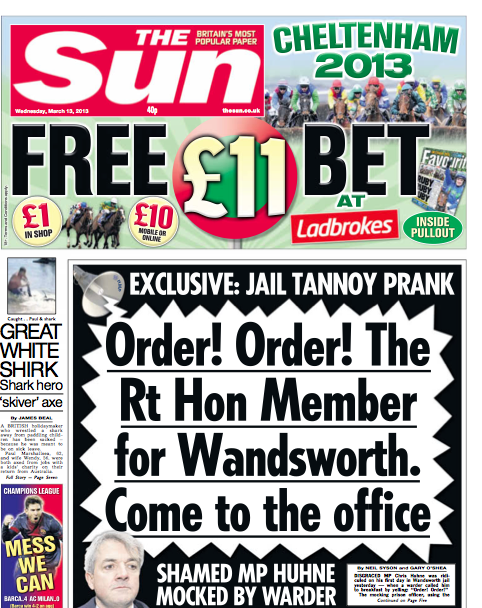
Sun in Clause 1 Accuracy PCC complaint

Hardly shocking to hear the words inaccurate and The Sun combined, but this is a good example for what it highlights about the serious deficiences of the PCC, but also (as the press wish to retain power over 'corrections') potentially its successor too.
The Sun admitted to making up a story about Huhne (or at least, that it couldn't produce ANY evidence to backing up the 'story'). It didn't apologise, and its 'correction' ... well, here's Roy Greenslade on that:
In other words, the main page one page story breached the first, and arguably most important, clause of the editors' code of practice, about accuracy.
Happy to set the record straight? You bet. Happy because the commission did not feel it necessary to censure the paper for publishing claims that it obviously could not prove. 
Happy because it published the mealy-mouthed correction seven weeks later at the foot of page 2. Happy because it had got away with a flier. And it didn't even have the grace to apologise.
And note a further irony. The story at the top of page 2 was a piece of "press freedom" propaganda against parliament's royal charter on press regulation, headlined "MPs told: hands off our press".
In the ongoing argument about the provisions of that charter, one of the key points of at issue is over the powers the regulator should have to determine where corrections should be placed. Editors do not want to be ordered where to place corrections. They prefer that they should have due prominence - the current situation.
Does anyone really think this correction on page 2 was adequate compensation for that page 1 splash?

Greenslade goes on to note that other papers had reprinted the 'story' - has Huhne really had a satisfactory outcome from the PCC????


See below for the original article.
sun Page 1 splash, 13 March - a story that The Sun could not substantiate The Sun published the front page shown above on 13 March. Under one of its trademark headlines, the "exclusive" article stated that Lib-Dem MP Chris Huhne had been ridiculed on his first day in Wandsworth jail.

Friday, 3 May 2013

Council papers exempt from press regulation

Minor detail, but still one that undermines the principle of press regulation: it has been noted this week that papers published by councils have managed to slip under the radar of the press regulation system, with no mention of them either in the Leveson recommendations or subsequent discussions. Here's Roy Greenslade once more:

Why are council papers exempted from press regulation?On a related subject, it appears odd that the government is prepared to allow council-owned papers to be exempt from a new system of press regulation.
And it's no wonder that Jim Fitzpatrick, Labour MP for the east London area of Poplar and Limehouse, should be in the forefront of attacking the exemption.
He serves part of a borough, Tower Hamlets, where the council publishes a weekly paper, East End Life, that has spent years strangling the life out of the commercial local paper, the East London Advertiser (also owned by Archant).
Fitzpatrick said: "East End Life has become too big and too biased. Hand-delivered to nearly every household in the borough it enjoys a privileged position without any real oversight."
Sources: Newspaper Society/Barking & Dagenham Council/East London Advertiser

You have the right to remain...anonymous? Police censorship

This topic overlaps with the broader issue of privacy and the tensions between the right to privacy enshrined under European law (augmented by further laws in most European states too) and the freedom to report, especially with regards to the powerful, and hold the actions of state agents/the powerful up to public scrutiny...

The UK police are actively campaigning (that statement itself suggests the role of the UK police has shifted over the past decade or so, as they are traditionally a strictly neutral agency, in theory at least) for the right of the media to name arrested suspects to be withdrawn.

See Roy Greenslade's blog post on this, where he quotes from press editorials and conflicting demands from the police over this (police on the Stuart Hall case were clear that it was the publicity that brought most victims forward - after his arrest), but fundamentally seeks to highlight the dangers of this in a democracy. [That's Stuart Hall the disgraced former BBC presenter, not the great academic who died in 2014]

Here's an excerpt:
The Mail devotes today's leading article, "Charging headlong towards a secret state", to the lessons of both the Warwickshire and Hall cases. It says:
"Make no mistake: the risks to justice and liberty of arresting and charging suspects in secret could not be more serious.
If the public are not allowed to know an innocent man or woman has been seized, how are they supposed to come forward with any information which could clear the accused, such as a cast-iron alibi?
Where a guilty suspect is concerned, there's a danger that witnesses' or, indeed, victims' evidence will never be heard."
And there is also an op-ed piece by John Kampfner in which he argues that "police secrecy insults democracy". He writes:
"The worst form of abuse of power is when the forces of law and order see their job as not just dispensing the law, but as making it and interpreting it in whatever way they see fit.
By deciding that individuals facing charges should not be named, the police appear to be doing just that."

Tuesday, 30 April 2013

Parliament v press over post-PCC regulator

Daily Mail splash on the battle over press regulation
See Media Guardian's press regulation micro-site for lots more news and analysis on this.
So... we initially had the Tories seeking to minimally apply Leveson, backed by most of the press (The Guardian and Indie took a separate line broadly favouring tougher regulation), seeing Cameron, otherwise criticised by the right-wing press for being insufficiently right-wing(!), hailed as a hero defending ancient freedoms.

Belatedly, the 3 big parties came to an agreement, and a beefed-up self-regulator, backed by Royal Charter (and with the threat of 'exemplary damages' hanging over any publications who refused to sign up), with no press industry right of veto over the members of the new organisation, was agreed. Notoriously, this was agreed at a meeting that ran into the early hours and included Hacked Off representatives.

Guardian led on the story
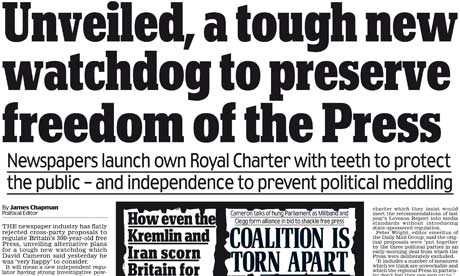
The press were not happy. Are not happy. So ... they've now come up with their own proposals! They reinstate the press' right to veto appointments. They keep a potentially stiff fines system (up to £1m - half of what the parties agreed upon?). They removed the right of parliament to reform this body with a 2/3 majority in the Commons. They argue such a measure would overturn '3 centuries of press freedom', a phrase you'll see used frequently in press coverage (referring to the 1694 abolition of licensing - that sounds better than 150 years (the abolition of stamp duty) which is more commonly seen as the moment when a free press was established, though Curran and Seaton would of course disagree!).

They also think they've managed to blocked the politicians' hopes of setting up a royal chartered organisation: according to their legal advice, if any royal charter is rivalled or seen as controversial it must be rejected.

The government, and major parties, say they're determined to press ahead.
The press are adamant they won't co-operate.

There is some divide amongst MPs: the influential Tory Chair of the Culture Select Committee, John Whittingdale, has written in the Sun stating he loves their proposal and would back it over the government's.
Its a year and a half since the PCC announced it was scrapping itself. It continues, with its successor still to be settled on.
Who will win this battle of wills and public opinion?
Sun was blunt in its threat to parliament

(article created after reading Roy Greenslade's typically sharp analysis, and Lisa O'Carroll's analysis of the likely political response to the press plan: http://www.guardian.co.uk/media/greenslade/2013/apr/26/press-regulation-national-newspapers and http://www.guardian.co.uk/media/2013/apr/29/newspaper-industry-royal-charter-david-cameron)

Thursday, 25 April 2013

EU Article 8 Right to Privacy + online issues

Its not just the press that raises issues around the right to privacy, enshrined in European law:
Article 8 – Right to respect for private and family life
1. Everyone has the right to respect for his private and family life, his home and his correspondence.
2. There shall be no interference by a public authority with the exercise of this right except such as is in accordance with the law and is necessary in a democratic society in the interests of national security, public safety or the economic well-being of the country, for the prevention of disorder or crime, for the protection of health or morals, or for the protection of the rights and freedoms of others. [source: Wiki]
ISPs and sites such as Google face huge pressures to store and pass on user data to governments and law enforcement agencies, and the UK is no exception, notwithstanding our supposedly high standards of democratic freedoms. Our governments, politicians and media routinely condemn 'authoritarian' regimes for snooping on their citizens and restricting freedom of expression, but how well does the UK's reputation stand up when scrutinised?

There are many examples of powers given to police and politicians to access our individual online footprints, including on social media and email, and no likelihood of anything but ongoing pressure (not least from the right-wing press, outraged as they are by any attempt to regulate the press as an attack on democratic values) to increase this. We're seeing this in April 2013 with the Conservative Home Secretary Theresa May attempting to pass new legislation granting government and police the right to access any part of 'suspects' online history, requiring the creation of a database of simply colossal scale:
May has fought hard for the legislation, designed to fill a growing gap in the ability of the police and security services to access records of the web and social media activity of serious criminals and terrorists.
The deputy prime minister sent the original legislation – the draft communications data bill – back to the drawing board after insisting it was first scrutinised by a committee MPs and peers.
The committee's withering verdict described it as "overkill", complained it "trampled on the privacy of British citizens" and said its cost estimates were "fanciful and misleading". They did however agree that new legislation was needed to plug the gap caused by rapid changes in technology.
The revised proposals tabled by May offered significant concessions but did not include movement on access to blogs or everyone's history of their use of websites or social media, or on requiring British phone and internet companies to intercept data from overseas providers. They proved insufficient to persuade Clegg to sign up to them.
Both parties campaigned on general election promises to roll back the surveillance state ... [source: Guardian]
I'll add links to previous posts on SOPA etc later.

Wednesday, 24 April 2013

1989 Calcutt Committee: parallels with Leveson today

To understand Leveson you really need to grasp the lessons of history - and there are striking parallels between Leveson, which is set to lead to a new self-regulator under some threat of statutory regulation if the press doesn't clean up its act, and Calcutt, which was ... basically the same in this regard. Both were set up after public outrage over tabloid excesses, with privacy issues to the fore. Both were set up with the existing press self-regulator, then the Press Council, now the PCC (although its chairman Lord Hunt announced its intention to replace itself back in December 2011), widely seen as having failed.

Indeed, both could/should have been replaced earlier if there was political will: the 3rd Royal Commission was scathing of the PC, whilst Calcutt's 1993 review strongly recommended statutory regulation be brought in. A weak Labour government in 1977 was no more willing than a weak Conservative government in 1993 to attract the damaging hostility of most of the press (although Labour could arguably have taken the chance as most of the right-wing press was very hostile anyway).

If we roll on to 2013, we once more see a weak government, at least the majority Conservative part of it, resisting pressure from the other parties to carry out the recommendations on press regulation, calculating that this will lose them vital press support needed for the 2015 general election. Indeed, since PM Cameron came out against many of Leveson's recommendations, carried in his initial November 2012 report, he has seen negative right-wing press coverage flip, with Cameron hailed as a hero safeguarding democratic values.

Its worth noting here that you shouldn't judge an argument's merits purely by its source! There is an important principle at stake, though it is arguable that freedom of the press is only meaningful if the nature (therefore the regulations around (concentration of) ownership and proprietorial interference) of the press is fundamentally altered.

Here's some links for further reading:
Not a link: Curran and Seaton cover this!!!!
Indie article from 1993 by Maggie Brown and Michael Leapman - possibly the best of its kind, you get both the history plus searing analysis of the backdrop and relationship between press and politicians.
Guardian obit on David Calcutt.
Incisive 1990 article from Index on Censorship.
PCC Wiki, incorporates the history.

The Leveson Inquiry

I'll gradually add resources, including links to past posts, here...

BASICS
Wiki.

CAMPAIGN GROUPS
Demotix covers Cameron/Murdoch protests.
Guardian articles on Hacked Off.

CRITIQUES
Andrew Gilligan is hardly a go-to guy for impartial views, but interesting argument here comparing the post-Leveson regulation to Denmark's system (DTele).
LeftFootForward: a leftist blog's articles on media.

Tuesday, 23 April 2013

Select Committee role: the 2011 Murdoch hearing

As well as the formal media regulators we have to consider the role of Parliament in overseeing media regulation. Governments can set up one-off investigations at times of scandal over media (usually press) behaviour, as happened with the 1970 Younger Committee, 1989 Calcutt Committee, and the Leveson Inquiry (July 2011, reported November 2012, with a 2nd part to come following the end of criminal trials). The 1985 Peacock Committee was set up with the aim of getting support for privatising the BBC or at least applying free market principles to the TV sector rather than any scandal.

When issues are seen as too sensitive for one party/government to deal with, the major parties can agree to set up a Royal Commission, as has happened three times on the press.

Its easy to overlook the important role of backbench MPs here.

Through the Culture, Media, Sport Select Committee they can investigate any area of the media, and have been holding regular hearings into press standards, privacy and libel, with some particularly famous hearings including appearances by the Murdochs. You can watch the entire July 2011 hearing at which Rupert Murdoch, having declared this was the "most humble day in my life", was attacked with a shaving foam pie and rescued by his much younger wife (who would divorce him in 2014). James Murdoch also took considerable umbrage at Labour MP Tom Watson's description of News Corp as a "mafia-like organisation".

Some useful links:
Wiki: DCMS
2010 guide to junior Culture ministers
Wiki: Culture Secretary
Shadow Culture Secretary (2013: Harriet Harman)
Mail report on the July 2011 hearing
NY Times on the same

Monday, 22 April 2013

BBC investigated by OfCom for effin boat race

Good example of the overlap between the self-regulatory BBC and the statutory (strictly speaking, quango) regulator OfCom, which polices the BBC's content too: complaints over the audible swearing of a cox during the annual boat race coverage. See http://www.guardian.co.uk/media/2013/apr/22/ofcom-investigate-bbc-boat-race-swearing.

Wednesday, 17 April 2013

2013 Defamation law reform

http://www.guardian.co.uk/law/libel-reform
Another topic to come back to, as its still working its way through Parliament. As I write, on 17th April, the Conservatives are being criticised for overturning a LibDem amendment which would force large companies to prove actual harm before being allowed to sue for libel, seen as vital to prevent the likes of Tesco (the example given in the article cited below) from preventing public criticism.
See http://www.guardian.co.uk/law/2013/apr/16/conservatives-block-key-libel-reform, and check http://www.guardian.co.uk/law/libel-reform for more updates on this.

Sunday, 14 April 2013

Thatcher death + media reg


Typical anti-BBC flak from the Mail elides public and the Mail (read more)
Its become a cliche - in most media, just not the right-wing press - that Thatcher's death and funeral has proven as divisive as her political career. We're also seeing both the press and broadcast TV engage in some informal self-regulation, with flak flying from a particularly gung-ho right-wing press (ie, every national daily bar the Indie/i, Guardian and Mirror) over any attempt to do other than celebrate and glorify the former PM and her contribution to national life.
I'll probably add more to this over time, but, writing before her controversial £10m funeral on Wednesday coming, here's a few pertinent points on this...

CLEAR BLUE LINES: HOW THE PRESS REPORTED HER DEATH
More below on the anti-BBC flak that featured in this, but you can see a very clear example of how the right-left binary functions in our national press through their coverage of her death.
You can view every front page here; analysis here.
The Mail and Mirror fronts sum it up rather neatly: grim-faced, divisive figure v bright, effervescent saviour (apt, as Maggie is held up as a divinity by the likes of the Mail)
Dissenting voices were rounded on by the Mail et al - indeed, the Telegraph took the highly unusual step of banning all reader comments on Thatcher's death/funeral, after they discovered many of these were highly critical of her. Of course, Leveson didn't mention online press content, so had nothing to say on this topic.


RIGHT-WING PRESS v (INdependent???) BBC
IN BRIEF: The BBC was roundly attacked for featuring any anti-Thatcher views, its presenters not wearing black ties from the moment Thatcher's death was announced, and not banning the Ding Dong the Witch is Dead track

Tuesday, 26 March 2013

Leveson summary at March 2013

JUNE 2014: This is great to look back at and get a clear sense of what was proposed, and how very, very tame (yet again!) the new self-regulator IPSO appears - where's the power to fine up to £1m that was mooted for example?!

See the post below for a great table on the responses of the 3 big parties; victims and the press to the emerging proposals for a new regulator.
Here, I've copied in a point-by-point FAQ from The Guardian summing up many of the points you need to know to really grasp this thorny issue
Its also necessary to put this into wider historical context, something we'll look at in more detail

The press regulation deal – Q&A

Is it statutory regulation, how would the new watchdog deal with phone hacking and what do victims of media intrusion think of it?

Newspapers on display in a shop
The new press regulations will affect the newspaper industry – including regional newspapers and news-related websites, and magazine publishers. Photograph: Paul Hackett/Reuters
How will press regulation be different now from before?
Culture secretary Maria Miller has claimed the prospect of investigations, fines of up to £1m for the worst or serial offenders will make it one of the toughest regulators in the world. While the predecessor Press Complaints Commission had no powers to impose fines, it was its lack of independence from newspapers that caused its demise. Its inaction over allegations of widespread phone hacking at the News of the World led it to being branded a "toothless poodle". The new watchdog should be completely independent. The press will have no veto over who sits on the board and serving editors will not be members of any committee advising on complaints, unlike the old system in which editors adjudicated on each other.
Is it statutory regulation or not? (And what is statutory underpinning anyway?)
The new regulator will be established by royal charter, not law. The charter will be entrenched in statute so it cannot be changed by ministers. It could only be amended if there is a two-thirds majority vote in both houses of parliament. The wording, d

Leveson responses by parties press victims (Guardian table)

Handy resource from the Guardian here - click here to go to their site and download it

Friday, 15 March 2013

Press unites against Labour-LibDem Leveson proposals

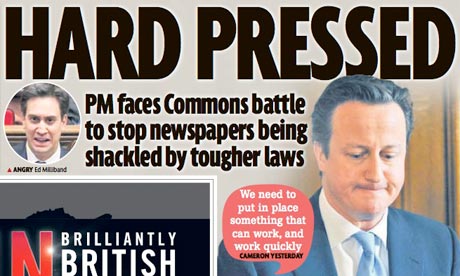
David Cameron has been the subject of much hostile coverage from a right-wing press apparently unhappy with the PM for not being right-wing enough. Today he is represented as an heroic figure, a true titan, single-handledly safeguarding British democracy from the terrors of state regulation of the press, whilst Miliband/Clegg (Labour/Lib Dems) are castigated as opportunistic anti-democratic hooligans with no sense of British history or traditions, taken in by the brazen buffoons of Hacked Off.

Which is one way to paraphrase today's extraordinary coverage of the ongoing parliamentary splits over how to implement Leveson's recommendations.
Roy Greenslade, as ever, provides a sharp summary of all this - you can see here a good example of what Chomsky's propoganda model referred to as "flak" (one of the five filters keeping radical or counter-hegemonic content out of mainstream discourse).
Political columnist Michael White also weighs in with a discussion of whether the PM is effectively in league with the Murdochs, fearing their wrath.

Cameron, the editors' press freedom hero, versus 'draconian' Miliband

Friday 15 March 2013
The majority of nationals lauded the prime minister for his opposition to statutory underpinning for a new press regulator


Daily Mirror
The Daily Mirror’s headline on Friday.

Prime minister David Cameron might have enjoyed his national newspaper coverage this morning. It was predictable that his opposition to statutory underpinning for a new press regulator would be greeted by headlines in his favour.