Showing posts with label statutory underpinning. Show all posts

Friday, 15 March 2013

Press unites against Labour-LibDem Leveson proposals

David Cameron has been the subject of much hostile coverage from a right-wing press apparently unhappy with the PM for not being right-wing enough. Today he is represented as an heroic figure, a true titan, single-handledly safeguarding British democracy from the terrors of state regulation of the press, whilst Miliband/Clegg (Labour/Lib Dems) are castigated as opportunistic anti-democratic hooligans with no sense of British history or traditions, taken in by the brazen buffoons of Hacked Off.

Which is one way to paraphrase today's extraordinary coverage of the ongoing parliamentary splits over how to implement Leveson's recommendations.
Roy Greenslade, as ever, provides a sharp summary of all this - you can see here a good example of what Chomsky's propoganda model referred to as "flak" (one of the five filters keeping radical or counter-hegemonic content out of mainstream discourse).
Political columnist Michael White also weighs in with a discussion of whether the PM is effectively in league with the Murdochs, fearing their wrath.

Cameron, the editors' press freedom hero, versus 'draconian' Miliband

Friday 15 March 2013
The majority of nationals lauded the prime minister for his opposition to statutory underpinning for a new press regulator
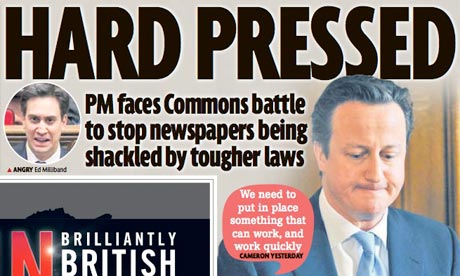

Daily Mirror
The Daily Mirror’s headline on Friday.

Prime minister David Cameron might have enjoyed his national newspaper coverage this morning. It was predictable that his opposition to statutory underpinning for a new press regulator would be greeted by headlines in his favour.


Thursday, 31 January 2013

Statutory Underpinning, the Leveson compromise

JUNE 2014: The consensus seemed to be that a new press self-regulator would be established, like the BBC, through a royal charter, NOT legisltaion (statutory), BUT that Parliament could intervene to change the terms of the regulator, its rules, if 2/3 of MPs and Lords voted in favour of this. Its that possible 2/3 vote that provided the 'underpinning'.

When reading about Leveson's recommendations you'll encounter the term STATUTORY UNDERPINNING frequently. So, what does this mean?

There's no precise answer as Leveson left the precise form of this open to debate among politicians. The principle, though, is clear enough: its a compromise between continuing self-regulation and introducing statutory regulation. It may mean that the press regulator is created through an Act of Parliament (so, has a legal status) rather than being created by voluntary agreement amongst newspaper owners. It may also mean that a review body is set up by Act of Parliament to regularly (probably annually) check that the press regulator is functioning as it should.

The idea also carries the possible threat of calling time in the last chance saloon: some politicians favour using statutory underpinning to give (essentially) self-regulation one final chance, BUT with the explicit reserve power passed at the same time which will see a more statutory body launched if this regulator fails as its predecessors have.

Statutory underpinning may also see a legally enforceable fining system introduced (also discussed is the idea of tax breaks for any companies to sign up to the new regulator, withdrawn from any companies - like Northern + Shell currently - who refuse to).

A few useful links:
http://www.telegraph.co.uk/news/uknews/leveson-inquiry/9711769/Lord-Justice-Leveson-insists-statutory-underpinning-does-not-amount-to-state-control.html
http://www.huffingtonpost.com/tim-fenton/leveson-statutory-underpi_b_2237834.html;
http://hackinginquiry.org/debunking/six-degrees-of-regulation/;
http://www.mediareform.org.uk/featured/labour-promises-to-vote-on-statutory-underpinning;
http://blogs.lse.ac.uk/polislevesonblog/2012/11/26/arguments-for-statutory-underpinning-of-regulation/;
BBC report on different ways to regulate press;

Cynicism of press reaction to Leveson

I'll maybe use this post to gather together various resources on this point at a later stage, but for now some comments by Harold Evans (editor of the Sunday Times as Murdoch took it over, and author of some classic books on the press) caught my eye (and Roy Greenslade's). If you haven't already, note the key term thats emerging from Leveson: STATUTORY UNDERPINNING
 
Here's a couple of snippets:
"As depressing as exposure of the dark arts has been, it is deepened by the cynicism and arrogance of much of the reaction to Leveson, coming from figures in the press who did nothing to penetrate – indeed whose inertia assisted – the cover-up conducted into oblivion by News International, a cover-up which would have continued, but for the skill of [Guardian journalist] Nick Davies and the courage of his editor [Alan Rusbridger]," Evans said, delivering the Cudlipp lecture at the London College of Communications.
He added: "A certain rowdiness [in the press] is a given, but the misrepresentation of Leveson's main proposal is staggering. To portray his careful construct for statutory underpinning as state control is a gross distortion."
...
He concluded: "I regard the Leveson plan, with the exceptions mentioned, as I regard the proposals on statutory underpinning – as an opportunity, not as a threat. What further might the British press do if it were free of internal and external restraints inimical to excellence? If the intellectual analysis of the heavies' tremendous flair in tabloid journalism were bent to more positive outcomes – such as Hugh Cudlipp dreamt in his youth and achieved so well in his prime?"
Cudlipp edited the Daily Mirror in the 1950s and 1960s and is regarded as one of the greatest British newspaper executives of the 20th century.
[Source]

Monday, 19 November 2012

STATUTORY PRESS REG pros + cons

This central debate is reflected in many posts on this blog + links lists; I'll look to bring those together here at a later date. For now, this useful argument between a victim of phone hacking and a crime writer opposed to statutory regulation of the press:

Are legal curbs the answer for Britain's errant newspapers?

Lord Justice Leveson is set to deliver his verdict on phone hacking. As politicians and journalists prepare for a battle over possible state regulation of the press, Jacqui Hames, the former Crimewatch presenter and hacking victim, debates the issues with Observer writer Nick Cohen
Jacqui Hames and Nick Cohen
Jacqui Hames, former police officer and Crimewatch presenter, and the Observer's Nick Cohen. Photographs: Antonio Olmos and Graham Turner
Dear Nick
I'll start with a bit of background. I'm best known for my stint on Crimewatch, between 1990 and 2006, but my police career started in 1977. I joined the Met at 18 and worked my way up through the ranks, serving as a detective constable until I took early retirement in 2008.
I gave evidence at the Leveson inquiry because in 2002 I was placed under surveillance by the News of the World. Up to that point my experience of the press was generally positive. On Crimewatch I experienced first hand the enormous benefits of working with the media to solve crime. That's not to say there weren't times when the different agendas conflicted, but that has to be expected.
That was all about to change. My then husband, a detective chief superintendent, appeared on Crimewatch to appeal for information in an unsolved murder. It was a gruesome case: a man killed with an axe outside a south London pub.