Friday, 22 June 2018
BBFC may gave 18 for all rape scenes

Wednesday, 20 June 2018
SOURCES BBC BIAS Most Beeb shows no lefties
Sunday, 10 June 2018
CHINA EU rainbow flag pixies block Eurovision
Saturday, 9 June 2018
FILM INDIA female scene told kiss off
Friday, 25 May 2018
IPSO Mirror guilty but Hopkins apology goes viral
This is perhaps a unique example...
Katie Hopkins, whose writing has sparked high profile complaints, 'won' with her complaint against the Mirror.
It's pithy apology has gone viral though, noting they were wrong to link her with drug abuse ... when it was racist abuse instead!!
https://www.thecanary.co/trending/2018/05/24/the-mirrors-apology-to-katie-hopkins-is-absolute-gold/
ADVERTISING Junk food neuromarketing lawsuit
The UK (Tory) government backtracked on pledges to get tough with the junk food industry, letting the industry instead come up with limited self regulation. Sounds familiar...
This is a lengthy report on moves toward a class action lawsuit against manipulation of children through marketing based on neuroscientific research. The ad industry regulator (limited power...) states it annually reviews advertising to children.
Food firms could face litigation over neuromarketing to hijack brains https://www.theguardian.com/society/2018/may/25/food-firms-may-face-litigation-over-neuromarketing-to-hijack-brains?CMP=Share_AndroidApp_Blogger
Wednesday, 23 May 2018
LIBEL Daily Mail owners sued by Pussycat Dolls
Pussycat Dolls sue Daily Mail owner over 'prostitution ring' story https://www.theguardian.com/music/2018/may/23/pussycat-dolls-sue-daily-mail-over-prostitution-ring-story-kaya-jones?CMP=Share_AndroidApp_Blogger
This on the same day they paid out, and removed a story (BUT note that they did not accept liability in doing so)
Daily Mail to pay Kate Maltby £11,000 costs over negative article
https://www.theguardian.com/media/2018/may/23/daily-mail-to-pay-kate-maltby-11000-over-negative-article?CMP=Share_AndroidApp_Copy_to_clipboard
Monday, 14 May 2018
IPSO damages payments scheme
- offering a low cost (max charge £100), quick arbitration scheme as an alternative to (expensive) law courts
- more than just ruling on whether a Code clause has been breached...
- ...damages of up to £60k could be paid out (closest we've come to fines)
- this was to undermine MPs support for (1) carrying out Leveson2, the 2nd half of his investigation (as agreed and announced by PM Cameron back in 2011 - to alleviate the huge pressure to act on press behaviour), and ...
- (2) the Tom Watson proposal to make law Leveson's report proposal that any papers NOT signed up to a royal charter-recognised regulator (ie, Impress; IPSO refuses to engage with this, as do the papers not in IPSO) would face large (the legal term is 'exemplary' = making an example of) damages payments AND would have to pay complainants fees win or lose!!!
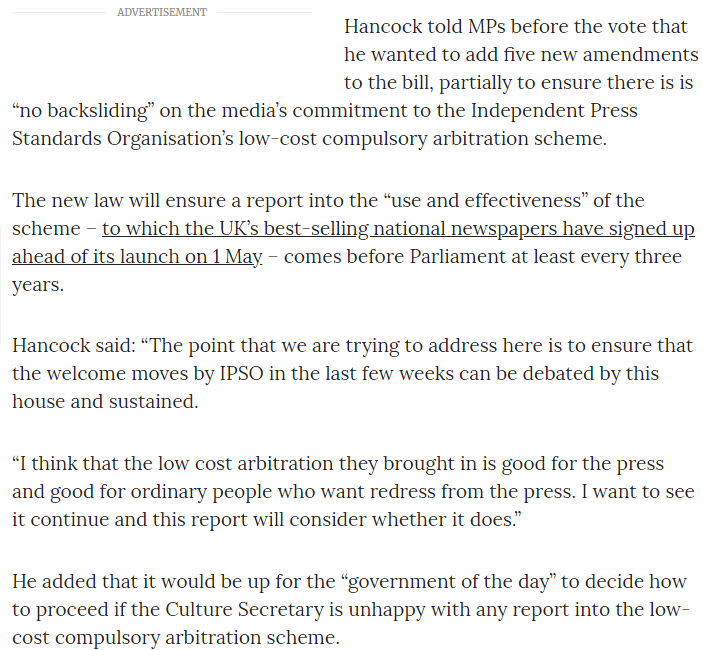
- it succeeded ... but only after the Culture Secretary announced that Parliament would review IPSO's arbitration every 3 years (see below for more)
- that will create a little bit of statutory regulation!
- moreover, surely if MPs declare themselves unhappy with how IPSO are running the scheme they'll then look at the wider system of regulation?
- So: under huge pressure from backbench bills/amendments seeking to bring in Leveson 2 AND serious financial penalties for royal charter refuseniks, IPSO rushed out a proposal to offer an alternative to sueing with possible damages + a £100 costs cap; MPs clearly didn't trust IPSO/press industry, so it took a government pledge to make a 3-yearly review of this arbitration scheme a legal requirement (statutory) for the Watson + Leveson2 proposals to be rejected
Press Gazette.


Here's more from the Press Gazette on the extraordinary steps the government took, hand in hand with a press industry MPs clearly didn't trust to stick to their word, to convince MPs to back down from voting through the Watson (royal charter refuseniks penalties) + Leveson2 bills/amendments:
...
PRIVACY 2018 SUMMARY
Privacy laws can be used by the rich + powerful to maintain secrecy over actions that may well be in the public interest to expose (though the red top approach that whatever the public is interested in is automatically in the public interest has commercial but not legal or ethical logic, and is clearly rejected by the Editors' Code, which limits the public interest defence to a few of its clauses).
Superinjunctions, to avoid even reporting on legal cases, such as that used by footballers Ryan Giggs and David Beckham (both rendered meaningless by widespread social media sharing) to try to hide news of affairs they have had, and in the Trafigura case to try and prevent The Guardian from reporting on pollution and the devestating social and health impact of this, are one level of this.
The most famous recent case, Max Moseley being reported as engaging in a Nazi-themed 'sex party' with escorts, with the Murdoch tabloids offering up free undercover video footage, was to found to lack any public interest in the courts - where the powerful are most likely to go, rather than PCC or IPSO. Injunctions seek to stop reporting before it happens (or the further repeating of already reported stories), the PCC/IPSO focus on POST-publication scrutiny (does an article breach the Editors' Code?).
Moseley's case is very well known, but he won damages at the high court for the breach of privacy. His position as a leader of autosports did not make his private antics a democratic issue! The reportage was simply to sell papers, not to make any meaningful contribution to public discourse.
The courts, especially with Tory government slashing of legal aid, are only really an option for the rich, however. The 2018 case of the Finsbury Park mosque leader who went to the courts AFTER going through the IPSO complaints process, and won £30,000 damages (libel, not privacy case) again indicates a higher level of protection available to those able to afford expensive legal fees.
****The newly announced IPSO arbitration scheme, which includes possible damages payments up to £60,000 and a capped complainant cost of just £100, is at the very least an attempt to address such concerns. See post.****
Moseley continues to get his revenge by funding Hacked Off and Impress.
The issue does often overlap with clauses on protecting children, notably the Toploader guitarist/celebrity wife case (Express, which had left the PCC...). Clause 6 is intended to specifically protect children's right to privacy, and IPSO's 1st ever case, raised as a 3rd part complaint by an MP (Sarah Wollaston) on the 'devil child' story (see http://mediareg.blogspot.lu/2017/05/ipso-children-rulings.html).
We have seen the rich and powerful protected by IPSO, as in the Harry on the beach case:

BUT - IPSO have also backed a member of the public in a case which led to calls for changes in the writing of the privacy and children's clauses (see Press Gazette article; IPSO said this was not necessary), to state that social media accounts should not be assumed to be public (their ruling here):


...
Thursday, 10 May 2018
TELEGRAPH PAY FOR LIBEL after IPSO rejected
There are 2 key points from this:
It's a great example of Chomskian flak AND anti-left-wing (anti-communism when the Manufacturing Consent book was originally published)
The legal case was taken up only after IPSO had ruled on the complaint. The IPSO response was deemed unsatisfactory.
Sunday Telegraph pays damages to mosque chief over Corbyn article https://www.theguardian.com/media/2018/may/09/sunday-telegraph-pays-substantial-damages-to-london-mosque-chief?CMP=Share_AndroidApp_Blogger
Tuesday, 8 May 2018
CHINA BANS PEPPA PIG Children's media censorship
Tuesday, 1 May 2018
FILM Church controlled US cinema for 40 years
An excellent video guide to the extraordinary story of how the US Catholic church gained control over US cinema content. They were able to block any item from scripts or costume design deemed morally unacceptable. Any studio (in the 1930s a big five controlled production and cinema through to a 1948 Supreme Court antitrust ruling) who dared defy the papal censor's pen and get a C rating (A for Acceptable, B for some morally dubious content, C for Condemned) faced a mass boycott. Millions of Catholics swore an oath not to view any C movies upon pain of losing their immortal soul!!!!
The short film asks WHY WOULD HOLLYWOOD ACCEPT THIS?!?!
The answer is the same reasons why the UK film industry set up the BBFC a century ago:
- fear of national governmental regulation
- trying to sidestep the many LOCAL censorship codes that were making distribution complex and expensive
The early years of UK TV regulation saw a similar level of pre-broadcast censorship, with shows details scrutinised before filming, and schedules also subject to tight control by the regulator.
The press ditched such controls several centuries ago!
https://youtu.be/HXZGKhpv8eg
Monday, 30 April 2018
POLICE CHOMSKIAN censorship of journalists
I've read about this story, a UK journalist secretly labelled a left-wing extremist by police + barred from attending major events to do his job, on various alternative news sites. It's somewhat reassuring to see it covered in the Grauniad too.
By taking legal action against the police, who refuse to detail or justify their decision and whose allegedly arbitrary profiling may be illegal, the wider institutional ideology of anti-left-wing (reflecting 1 of the propoganda model's 5 filters), linking police and secret services and seen in employment blacklists and actions such as the extraordinary demand that The Guardian physically destroy computers used for reporting the Edward Snowden leaks, may be exposed to unexpected scrutiny. If reported by the rest of the press and mainstream media that is, as opposed to firing flak at the journalist who has brought the case, seeking to undermine his reputation and image.
A free press? I’m a UK journalist, but the police labelled me an extremist https://www.theguardian.com/commentisfree/2018/apr/30/free-press-uk-journalist-police-extremist-legal-action?CMP=Share_AndroidApp_Blogger
Sunday, 29 April 2018
DISTRIBUTION MONOPOLY do not pass go
This is another example of why a narrow focus on content alone is clearly not capable of producing effective newspaper regulation.
Wider law, the Competition and Mergers Authority, might step in, but a lack of competition in newspaper distribution and the poor quality service, with delivery times by freelance drivers making customer delivery difficult, is leading to some newsagents to just give up.
Newsagents are suffering in a sorry game of monopoly https://www.theguardian.com/media/media-blog/2018/apr/22/newspaper-wholesaler-delivery-corner-shop-closures?CMP=Share_AndroidApp_Blogger
Friday, 27 April 2018
BBFC Red Sparrow gets favourable 15
 (placeholder for now, TBC)
https://www.theguardian.com/film/2018/jul/19/hugh-jackman-logan-most-complained-about-film-2017-bbfc
$69m IP/star vehicle for Jennifer Lawrence (based on hit novel optioned + adapted by Fox).
The BBFC judged the original cut an 18, but advised on a specific cut (to a garroting scene) to get a 15.
The marketing for the film caused another controversy over JL's low cut dress. (IndieWire)
BBFC.
Wiki.
RtnTmts.
IMDB.
 IMDB Parents Guide. Note the 12 rating in France.
Official site.
Trailer.
MelonFarmers (be aware of dubious links on this site)
Reviews: Guardian (Observer); Ebert; TheAtlantic;
Perhaps surprisingly, The Daily Mail didn't manage to get outraged by the movie:

 |
| MelonFarmers. |