Resources and analysis on the topic of media regulation, particularly for the A2 Media exam, Section B. Major case studies include the film industry, music video and the press, with major players such as Murdoch, OfCom and the government considered. If using materials from this blog, please credit the source - Dave Burrowes, Media Studies @ St George's School
Wee bit careless to present so few ethnic minority faces?
I can't recall seeing quite so detailed, especially from a tabloid, as this before - an all-encompassing manifesto that quite neatly provides the clearest possible evidence of The Sun and thus Murdoch's (as much as he absurdly continues to deny influencing his papers' viewpoints and agenda!) ideological orientation.
The timing is smart - the political parties are yet to publish their manifestoes, and UKIP, Labour, Lib Dems and Tories (the major right-wing/centre-right parties) will all feel some pressure to adhere to some of this classic neo-liberal agenda.
Roy Greenslade has been discussing Murdoch's recent, rather surprising, use of Twitter to make public his previously 'private' (they were clear enough if you read his papers!) views and partisanship:
For Murdoch’s inner circle, such open political expression is a thing of wonder. Before the age of social media, he kept himself firmly in the background, careful not to expose his own public views while actively seeking to sway elections through the editorial endorsements in his many newspapers across the globe.“He made clear to his editors which politicians deserved support and those that didn’t,” said a former News Corporation executive. “But unless it was time for an endorsement, those conversations remained private.”The former executive added: “Now with his Twitter feed, the world can see how he is thinking all the time. Which is unusual for Rupert, who liked to keep his own counsel. It has surprised many of us to see him go so public.”
Its worth reading his article in full. A bit more:
Murdoch watchers see the dual-track emoting of his Twitter feed and the editorial pages of his newspapers as symbiotic. The social media site does not only provide the media magnate a direct channel to vent his opinions – it also acts as a prompt for Murdoch’s editors, they say. David Folkenflik, who is NPR’s media correspondent and the author of Murdoch’s World: The Last of the Old Media Empires, said that “Twitter has changed the ball-game. Every Murdoch editor around the world will be monitoring that feed very closely – they check it repeatedly – to see whether he’s expressed himself again.” As the power of newspapers has waned amid the fragmentation of digital discourse, the relationship between Murdoch and his newspapers has arguably turned upside-down. Before the proliferation of other news sites, he used his newspapers to amplify his personal political views; today, with the News Corp empire bigger than ever, he uses his personal Twitter feed to amplify the influence of his newspapers. As the former News Corp executive put it: “As newspaper endorsements become less and less important, this is one way for him to maintain a high political profile.” That trend remains visible in the UK, where Murdoch pushed the power of newspaper endorsements to the limit with the Sun’s famous 1992 front page on the day after the Conservative party’s general election victory: “It’s the Sun Wot Won It”. Today, the Sun has to work that much harder to have the same impact – this week it launched the endorsement process for the UK’s May general election, 100 days before the event. It dubbed the paper’s campaign the “Sunifesto” and flagged it as “100 days to save Britain”.
THE SUNIFESTO: ANALYSIS
As to that 'Sunifesto', there are a few especially interesting points to consider:
Former
culture secretary sought assurances from then prime minister that there
had been no backdoor deal with Rupert Murdoch on cross-media ownership
rules
Tessa Jowell gives evidence to the Leveson inquiry
Tessa Jowell, the former culture secretary, has told the Leveson inquiry that she sought assurances from then prime minister Tony Blair that there had been no backdoor deal with Rupert Murdoch when she was given the job in 2001. The
former Labour cabinet minister had the task of reviewing cross-media
ownership law as part of the Communications Act that was due to go
before parliament at that time – and wanted to be assured she had a free
hand in rewriting the rules. Giving evidence before the judicial
inquiry into press standards on Monday morning, Jowell said she saw
Blair "within a couple of days of my appointment". She asked the prime minister about whether his relationship with the media mogul would colour her thinking. "I
asked him whether or not any deal had been done with Rupert Murdoch on …
the cross-media ownership rules. He gave me an absolute assurance which
I completely accepted that there had been no prior agreement," she
said. Given that, Jowell said that she told Blair that it was best
"if you don't see the parties", by which she meant any interested media
owners, and that it was her job to "take this and come back to you with
proposals". She told Lord Justice Leveson that Blair was content with
this approach. Jowell steered through the Communications Act,
which eventually saw a partial relaxation of cross media ownership rules
– allowing US groups such as Disney and Murdoch's News Corporation to buy British free to air broadcasters. That could have allowed News Corp to buy Channel 5. The
former culture secretary also told the inquiry that Blair asked her to
see if cross-media ownership rules could be relaxed to the point where
News Corp could have bought ITV or Channel 5. Jowell
had presented proposals that would have prevented News Corp, or any UK
newspaper owner with a market share of more than 20%, from taking over
ITV or Channel 5. However, at a private meeting in March 2002,
Blair asked for "further discussion of the merits and effects of the
different approaches we could take to the rule preventing anyone owning
20% of both the national newspaper market and a Channel 3 [ITV] or
Channel 5 service", according to a note prepared by officials at
Jowell's Department for Culture, Media and Sport. Jowell told the
inquiry that said she had no detailed recollection of the conversation
at the meeting. But she acknowledged that when it came to cross media
ownership rules Blair's "instinct in relation to this were, I think,
more deregulatory than mine". Shortly after, a second meeting
between Jowell and Blair concluded that it was appropriate to allow News
Corp to buy Channel 5 – but not ITV. An official note from April 2002
confirms this final, agreed position. Jowell said the change in
thinking was an example of the normal policy development process and
that the proposed change in rules as regarding Channel 5 was not a big
development. The Channel 5 proposal went forward and became part
of the Communications Act which was passed by Parliament, while the ITV
restriction remains today.
JUNE 2014 - IN BRIEF: Analysis of what the Tory-led government might change in media policy/regulation through a new Communications Bill. This bill seems to have quietly disappeared! Its not among the final 13 announced in June 2014, before the May 2015 general election.
Analysis of the decision to delay the Communications green paper at http://www.guardian.co.uk/media/2012/may/17/communications-green-paper-delayed. With Culture Secretary Hunt preoccupied with preparing for an appearance at Leveson, and facing calls for his resignation (163 emails released by Leveson appear to show he kept News Corp briefed on gov policy even as he was supposed to be assessing the company's bid to take over the rest of BSkyB in his capacity as gov minister), the new bill on media laws has been delayed, and won't now appear until autumn 2012. Even then, it will probably be delayed further as Leveson reports in October 2012, so his recommendations will probably be worked into a revised bill which may not be released until 2013.
Indeed, (this is my analysis, not whats said in the article) given the accusations of collusion, possibly criminal, between Hunt + PM Cameron with Murdoch/News Corp, any media/communications bill from this Tory-led gov are likely to face long drawn out debates, and may struggle to get passed before the 2015 election.
What direction might a new bill take? In a word, deregulation (again, this is my analysis, not whats said in the article): slashing regulation of the terrestrial 'public service broadcasters' (allowing ITV, C4, C5 to broadcast less news/regional/children's programming, lengthen the amount of ads per hour, and allow further concentration of ownership, such as a merger between C4 + C5), and probably some form of attack on the BBC (which Tory London Lord Mayor Boris Johnson claimed this week [May 2012] was "left-wing" and must in future be headed by a Tory [he seems to ignore the fact that the BBC Chairman Lord Patten is a Tory!!!]). As far back as 1985, the Conservatives have sought to kill the idea of an independent, publicly-owned broadcaster: when Thatcher appointed Lord Peacock to report on the future of the BBC + UK TV generally, she expected him to recommend privatisation - but his 1986 Peacock Report explicitly stated that a free market in TV would simply lead to dumbed-down TV and argued that a license fee-funded independent BBC, NOT funded by advertising, should remain as a guarantee of quality UK TV). See this post for more on the Tory/right-wing hatred of the BBC.
[Whats this 'Communications green paper' I hear you ask: 'The
green paper marks the start of a legislative process that will
culminate in a communications bill scheduled for the 2014/15 session of
parliament.' Don't forget you have access to links about the main communications acts from the past 30 years at this post, links such as these:
Policy thoughts go on the back burner …
Culture secretary Jeremy Hunt had hoped to publish the communications
green paper in the spring. Photograph: Dominic Lipinski/PA
The planned publication of a communications green paper has been put on hold until after Jeremy Hunt, the culture secretary, has given evidence to the Leveson inquiry and dealt with accusations that he favoured News Corporation in its negotiations to buy all of BSkyB.
Those
close to Hunt's Department for Culture, Media and Sport say the
communications green paper, which will set out the government's initial
policy thinking in areas as diverse as internet piracy, public service broadcasting and spectrum allocation, has largely been written but is now unlikely to be published until autumn at the earliest.
Hunt and his deputy, Ed Vaizey,
had hoped to publish the document in the spring but Hunt's attention
has been concentrated on the need to give a full account to Lord Justice
Leveson of his relationship with Rupert Murdoch's company and see off Labour calls for him to resign.
One
source said Hunt and the DCMS were distracted by the Murdoch
controversy and it would be impossible for the document to be published
until September at the earliest, assuming the culture secretary gives a
successful performance before the judge.
There are also
suggestions that the green paper could be shelved completely, with
ministers instead moving to publish a white paper that by then would
incorporate any relevant recommendations arising from the Leveson
inquiry about the future of press regulation.
Leveson is due to
report in October, and if his document appears before the green paper,
it may have to be redrafted to include the government's initial response
to his findings.
If Hunt were to be replaced, a new culture
secretary would want to review the document before agreeing to release
it. The culture secretary has been under fire after 163 pages of emails
written by News Corp lobbyist Frédéric Michel were released by the
company to the Leveson inquiry.
Those emails, written over several
months, appeared to show that Hunt's office was passing information
about the minister's BSkyB bid approval process to the company during
2010 and 2011. Michel repeatedly described information he had obtained
to his boss, James Murdoch, as emerging from Hunt himself.
The
culture secretary denied there was an inappropriate relationship
between himself and News Corp. But his special adviser Adam Smith did
resign when it emerged that the bulk of Michel's contact was with Smith
rather than Hunt directly.
Hunt said that the "volume and tone" of
the Smith/Michel communication could not be justified, but insisted
that he oversaw the Sky bid correctly in a "quasi-judicial" manner.
Ministers
are still officially insisting that the green paper will emerge in the
spring. But the joke understood to be circulating in at the DCMS is that
spring in Whitehall can run from anywhere from February to November.
The
green paper marks the start of a legislative process that will
culminate in a communications bill scheduled for the 2014/15 session of
parliament.
Meanwhile Harriet Harman, Labour's deputy leader, told
a meeting of the campaign group Hacked Off that there should be the
"equivalent of the knife amnesty" for newspapers and politicians before
regulatory reforms are introduced for the press. She said both sides
needed to stop attacking each other and start with a clean slate once
the Leveson inquiry made its recommendations.
"At the end of the day what I hope is that we have is no victors and no vanquished here," she said.
Rather unexpected contribution to the current debate, from Tele columnist Peter Oborne; he proposed in his appearance before Leveson that both politicians and journos should be jailed if they knowingly lied. He also attacked the over-cosy relationship between press/politicians, saying that political coverage had become little more than two elites talking within a closed circle; the press were manifestly failing to carry out their vital democratic function of holding government + politicians generally to account. He highlighted the attendance of PMs, gov ministers, party leaders and other media bigwigs at the annual News International bash as a strong symbol of this unhealthy lack of distance, and the power of Murdoch in particular. He also criticised the way the Sun in particular covered the Iraq and Afghanistan wars, which actively pushed readers to support "our boys", and the wider press for ignoring the Guardian's isolated reportage of the Hackgate scandal.
Leveson didn't seem impressed by the idea of criminalising lying, but its an interesting one - and notably doesn't involve a regulator but wider laws.
Leveson inquiry: make political lying a criminal offence, says Peter Oborne
Severe sanctions could restore politicians' and journalists' integrity, Daily Telegraph columnist tells hearing
Lisa O'Carroll, guardian.co.uk,
Peter Oborne has called for the integrity of parliament to be restored
Peter Oborne, the Daily Telegraph columnist, has told the Leveson inquiry that "political lying" should be made a criminal offence for both politicians and journalists reporting on Westminster.
Oborne,
the Daily Telegraph's chief political commentator, said during his
witness appearance at the inquiry on Thursday that it had become far too
easy for politicians to lie or make misleading statements to parliament
and a severe sanction might restore some integrity in Westminster.
He
said directors of publicly listed companies could go to jail if they
make false or misleading statements on shares and assets. "Whereas
politicians I have noticed, freely make entirely false statements about
how they are conducting themselves and why one should vote for them,"
Oborne added.
He said it would very healthy if such a criminal sanction could be applied to politicians and journalists.
Lord Justice Leveson put it to him that such a draconian penalty would have "a chilling effect upon journalism".
Oborne
said it could be a workable system if the standard of proof was high
enough. "A lie, is a deliberate untruth, something you write or
something which is not true, which you say or right down in the full
knowledge that it is not true."
Earlier, Oborne told
Leveson that journalism was a "noble profession", but many in the lobby
system in Westminster did not seek out the truth but merely "suck up to
powerful people".
He decried the cosiness between successive governments and News International, which he said was regularly brought into the "inner sanctum" with privileged seats at Labour and Tory party conferences.
The
News International annual party in the conference season had an
"extraordinary power", attended by the "entire cabinet" and "influence
brokers and the senior members of the media class", he said.
"Our
democracy was starting to become a private conversation between elite
groups," Oborne added. "Political reporting, as I observed it, had
become a matter of private deals, arrangements invisible to voters."
He
blamed new Labour for creating this system where favours would be
traded with pet journalists, while those who remained fastidiously
outside the system, such as the Daily Telegraph's former political
editor George Jones, would be "frozen out".
He said Labour had
created a "narrative … that there was a hostile press" when, "on the
contrary", they had "manipulated a particular kind of acceptable public
truth".
In a sustained attack on Labour and its policy of spin, he
said "they were interested in truth if it served their political
purpose".
He called for a new "apartheid" to be introduced which would put some distance between politicians and journalists.
"[We
are at] a moment in British history where a political system is coming
to an end, based on media dominance. Parliament has an opportunity to
re-assert its traditional function," Oborne said.
He added he was
pleasantly surprised when he heard from a "relevant" figure that when
David Cameron first became Conservative leader he decided to keep some
distance from Rupert Murdoch.
Oborne
said a News International source had told him that they had coached
Cameron on what to say when he first met Murdoch, but he had not played
ball and the meeting went "badly".
The inquiry has heard that
Cameron became close to the former News International chief executive
Rebekah Brooks, attending her wedding in June 2009 and signing off texts
"LOL".
Oborne was also critical of the Sun's coverage of the Iraq
and Afghan wars. He claimed the Sun's one dimensional coverage of "our
boys" had failed to engage on the serious questions of Britain's
complicity in rendition, illegal killings, use of drones and human
rights abuses.
He added that there was an unethical silence on
this across Fleet Street with some notable exceptions, such as the
reporting by the Guardian's Ian Cobain.
Oborne said the press had
also operated an "omerta" when it came to phone hacking but urged
Leveson not to conclude that this was because any alleged illegal
activities were going on at rival papers.
He put it to Leveson
that there should not be more press regulation because of the
phone-hacking scandal because this was a failure of the police to
enforce the law.
Leveson said this would be like a motorist caught speeding protesting that the police had not enforced the law.
V useful article here which examines the concept of pluralism - the concept of having diverse opinions present and represented through our media, not a narrow range or limited number. This is a 'wider social issue', and also tied to the very dea of regulation: without some regulation the 'free market' would inevitably lead to concentration of ownership even worse than we currently have, and the ever-larger scale of these few global conglomerates would likely narrow even further the diversity of views and opinions represented. Such corporate behemoths as News Corp are unlikely to favourably report moves to increase Corporation Tax, the top end of Income Tax, to boost wages or strengthen trade union power, because none of this is in the self-interest of a large corporation.
Enders & Goodall specifically suggest a 15% market share (of all media, not just a single sector whether TV or press) should the maximum permitted; any company which rises above this should be forced to sell off media assets until they fall below 15% again. As we'll see, OfCom have in the past forced News Corp to sell shares in ITV companies as this went against the fundamental principle of pluralism.
The Dow Jones news ticker in New York's
Times Square displays part of the headline on News Corp's bid to buy
the Down Jones Company in May 2007. Photograph: Brendan Mcdermid/REUTERS
In the past few days an impressive political unanimity has been
developing behind the view that Britain needs to reintroduce clear
limits on media ownership and define what plurality means. The UK
dismantled most of the specific rules governing who can own media
companies in 2003, and in all but a few cases the competition
authorities were left with complete autonomy.
Indeed, only a last-minute amendment to the Communications Act allowed governments to intervene to protect plurality. Without that protection, the full takeover of BSkyB
would have proceeded with no check whatsoever, even though it enlarged
the scale and scope of News Corporation, already the largest media
company in the UK and, indeed, the world.
The concept of plurality
remains entirely undefined in law. To date Ofcom and other bodies have
largely assumed that plurality is entirely about the media providing a
wide range of news and opinion to citizens. In the UK, News Corp
controls over 35% of newspaper circulation and most news on commercial
radio and BSkyB, and has significant financial muscle. An increase in this scale and scope could have detrimental effects on all News Corp's competitors, and thereby on British democracy.
The following is an example of how you can combine Use of Examples (a case study of this instance of hacking), EAA + Use of Terminology (in analysing the pros/cons of the concept of 'public interest defence', and citing specific law which may overrule this: the Computer Misuse Act). Below you'll find differing lines from Sky, Guardian, Indie, Hacked Off and Reuters, plus a linked Roy Greenslade article on the wider concept.
Huge story breaking 1st week of April 2012: Sky has admitted to using email hacking for at least two stories it ran ... but claims there is a public interest defence. Sky trumpeted about 'obtaining' emails from the faked-death John Darwin in 2008; his wife pocketed a fortune from life insurance and they went to Panama to live it up (then rather foolishly posed for pictures with an estate agent). Here's how The Guardian broke the story. An excerpt:
Making only a minimal effort to hide the basis of the story, Tubb's report said Sky News had "discovered an email" from John to Anne dated 31 May 2007,
in which he says changes to visa regulations meant he could no longer
stay in Panama, where he was hiding on a tourist visa. The report cited
evidence from several emails between the couple, including a "final
email" from Anne that was not, "as suggested in court", evidence of a
"massive row" between them, an email that Tubb said had been "handed to
the police by Sky News".
The story displayed a picture of "John and Anne Darwin's masterplan", showing a detailed diagram that had apparently been produced by Darwin, and claimed to have obtained detailed financial accounts prepared by Darwin. In another story, published in November 2009, Tubb quoted directly from an email written by John Darwin to his wife in 2007, explaining that their property in Panama had been valued at $1m and adding: "You're a filthy rich gringo". But a link to copies of the couple's emails is now dead.
The
broadcaster also published a voicemail message on its website, dated 19
May 2007, in which Anne Darwin is clearly heard leaving a message for
her husband. The voicemail, part of an interactive graphic,
ends with her saying "I'll try and catch you tomorrow. Love you,"
which the broadcaster said showed "she was doing as much of the running
as he was".
Sky News said this was not obtained by phone hacking
and a spokesman said: "All of the material obtained by Sky News was via
the Darwins' computer-based email accounts. As we have said previously,
Cleveland Police were made aware of the source of the material when Sky
News shared it with them. We stand by our editorial decisions, which
were justified in the public interest."
Some
of the most important stories have involved breaking the rules in some
way. For example, the Daily Telegraph's exposé of the MPs' expenses
scandal was very clearly in the public interest, but only happened
because the newspaper took the decision to pay for stolen data. They
have been widely applauded - deservedly - for doing so.
Indeed,
if it was looking for further examples, the Guardian could have found
them much closer to home. Its respected investigative reporter David
Leigh has admitted hacking a phone in pursuit of a story. The Guardian's
sister paper, the Observer, was found on more than 100 occasions to
have commissioned information from a notorious private investigator, who
was convicted in 2006 of illegally obtaining private data. In each
case, a public interest justification has been claimed.
Although no one has been arrested for the computer hacking, there is no
public interest defence in the Computer Misuse Act. The development
follows the revelation that The Times, another part of the Murdoch news
operation, was found to have hacked into the emails of the blogger
Nightjack, who the paper outed as the serving police officer Richard
Horton.
“Hacked Off today renews its calls for a public interest defence in
law after Sky News confessed to hacking into emails, claiming it did so
‘in the public interest’.
“Yet because there is no public interest defence in law for the
Computer Misuse Act, Sky has to rely on the discretion of the
prosecution services not to prosecute.
“This is unsatisfactory. If Sky News believes there is a clear public
interest to hack into emails then it should have a clear and consistent
legal defence for its actions.
“Journalists would feel confident to speak openly about the methods
they use to discover stories in the public interest if they knew there
was a proper defence for their actions in law.
“Hacked Off hopes that the Leveson Inquiry will recommend the
introduction of a formal public interest defence in law for the
protection of journalism.”
When Murdoch first arrived in Britain it was still largely the practice for newspaper owners to be Lords or minor aristocrats; seen as a crude, vulgar Australian, his appalled rivals gave him the nickname of 'the dirty digger'. This has relevance for this exam Q given the way he has systematically undermined another key pillar of Britishness.
If WW2, and the pride that the endeavours of the British Army (and airforce and navy) created, were key to the cementing of a common British identity in the last century, then so too was the popular support for the Royal Family. Seen (and certainly marketed as by the state) as a symbol of nationhood, the monarch and her family had achieved a hegemonic status as unquestionable icons of Britishness.
The Australian Murdoch brought with him an intense dislike for the privilege and elitism of monarchy, and personally loathed the idea that a British monarch was his head of state. This republicanism is one rare exception to Murdoch, and his paper's, thoroughly right-wing ideology (left-wingers are more commonly associated with hostility to monarchy).
As the Sarah Ferguson sting in his NoTW recently showed, Murdoch's papers are prepared to be brutally ruthless in their pursuit of sensational, paper-selling scoops, no matter how much damage this does to the whole system of monarchy. Before he came, anything like this would have been utterly unthinkable.
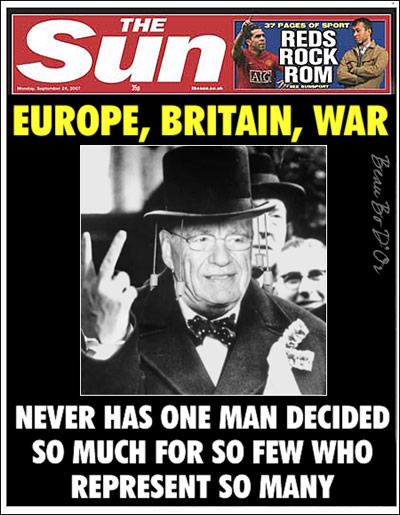
The image is from http://www.septicisle.info/uploaded_images/rupert_murdoch_europe-725350.jpg The following article is from one of the many leftist or liberal sites, zines and blogs that have prospered on the web even as the mainstream, mass-market press has grown ever more narrow in its right-wing ideological slant; the Curran & Seaton book (Power Without Responsibility) I keep recommending tracks how this has come about in the UK, demolishing the myth of a liberal press.
The article is a comprehensive attack on Murdoch's record, values and operating methods, and is a useful summary of many of the key right-wing policies he's associated with (and thus NewsCorp).
Who is Rupert Murdoch?
July 16, 2004
In recent years, Australian-born billionaire Rupert Murdoch has used the U.S. government's increasingly lax media regulations to consolidate his hold over the media and wider political debate in America. Consider Murdoch's empire: According to Businessweek, "his satellites deliver TV programs in five continents, all but dominating Britain, Italy, and wide swaths of Asia and the Middle East. He publishes 175 newspapers, including the New York Post and The Times of London. In the U.S., he owns the Twentieth Century Fox Studio, Fox Network, and 35 TV stations that reach more than 40% of the country...His cable channels include fast-growing Fox News, and 19 regional sports channels. In all, as many as one in five American homes at any given time will be tuned into a show News Corp. either produced or delivered." But who is the real Rupert Murdoch? As this report shows, he is a far-right partisan who has used his empire explicitly to pull American political debate to the right. He is also an enabler of the oppressive tactics employed by dictatorial regimes, and a man who admits to having hidden money in tax havens. In short, there more to Rupert Murdoch than meets the eye.
In 2003, Rupert Murdoch told a congressional panel that his use of "political influence in our newspapers or television" is "nonsense." But a close look at the record shows Murdoch has imparted his far-right agenda throughout his media empire. MURDOCH THE WAR MONGER: Just after the Iraq invasion, the New York Times reported, "The war has illuminated anew the exceptional power in the hands of Murdoch, 72, the chairman of News Corp… In the last several months, the editorial policies of almost all his English-language news organizations have hewn very closely to Murdoch's own stridently hawkish political views, making his voice among the loudest in the Anglophone world in the international debate over the American-led war with Iraq." The Guardian reported before the war Murdoch gave "his full backing to war, praising George Bush as acting 'morally' and 'correctly' and describing Tony Blair as 'full of guts'" for his support of the war. Murdoch said just before the war, "We can't back down now – I think Bush is acting very morally, very correctly." [New York Times, 4/9/03; Guardian, 2/12/03] MURDOCH THE NEOCONSERVATIVE: Murdoch owns the Weekly Standard, the neoconservative journal that employed key figures who pushed for war in Iraq. As the American Journalism Review noted, the circulation of Murdoch's Weekly Standard "hovers at only around 65,000. But its voice is much louder than those numbers suggest." Editor Bill Kristol "is particularly adept at steering Washington policy debates by inserting himself and his views into the discussion." In the early weeks of the War on Terror, Kristol "shepherded a letter to President Bush, signed by 40 D.c= opinion-makers, urging a wider military engagement." [Source: AJR, 12/01] MURDOCH THE OIL IMPERIALIST: Murdoch has acknowledged his major rationale for supporting the Iraq invasion: oil. While both American and British politicians strenuously deny the significance of oil in the war, the Guardian of London notes, "Murdoch wasn't so reticent. He believes that deposing the Iraqi leader would lead to cheaper oil." Murdoch said before the war, "The greatest thing to come out of this for the world economy...would be $20 a barrel for oil. That's bigger than any tax cut in any country." He buttressed this statement when he later said, "Once [Iraq] is behind us, the whole world will benefit from cheaper oil which will be a bigger stimulus than anything else." [Guardian, 2/17/03] MURDOCH THE INTIMIDATOR: According to Agence France-Press, "Rupert Murdoch's Fox News Channel threatened to sue the makers of 'The Simpsons' over a parody of the channel's right-wing political stance…In an interview this week with National Public Radio, Matt Groening recalled how the news channel had considered legal action, despite the fact that 'The Simpsons' is broadcast on sister network, Fox Entertainment. According to Groening, Fox took exception took a Simpsons' version of the Fox News rolling news ticker which parodied the channel's anti-Democrat stance with headlines like 'Do Democrats Cause Cancer?'" [Source: Agence France-Press, 10/29/03] MURDOCH THE NEWS EDITOR: "When The New York Post tore up its front page on Monday night to trumpet an apparent exclusive that Representative Richard A. Gephardt would be Senator John Kerry's running mate, the newspaper based its decision on a very high-ranking source: Rupert Murdoch, the man who controls the company that owns The Post, an employee said yesterday. The Post employee demanded anonymity, saying senior editors had warned that those who discussed the Gephardt gaffe with other news organizations would lose their jobs." [NY Times, 7/9/04]
Just as Fox claims to be "fair and balanced," Rupert Murdoch claims to stay out of partisan politics. But he has made his views quite clear – and used his media empire to implement his wishes. As a former News Corp. executive told Fortune Magazine, Murdoch "hungered for the kind of influence in the United States that he had in England and Australia" and that meant "part of our political strategy [in the U.S.] was the New York Post and the creation of Fox News and the Weekly Standard." MURDOCH THE BUSH SUPPORTER: Murdoch told Newsweek before the war, Bush "will either go down in history as a very great president or he'll crash and burn. I'm optimistic it will be the former by a ratio of 2 to 1…One senses he is a man of great character and deep humility." [Newsweek, 2/17/03] MURDOCH THE BUSH FAMILY EMPLOYER: As Slate reports, Murdoch "put George W. Bush cousin John Ellis in charge of [Fox's] Election Night vote-counting operation: Ellis made Fox the first network to declare Bush the victor" even as the New Yorker reported that Ellis spent the evening discussing the election with George W. and Jeb Bush. After the election, Fox bragged that it attracted 6.8 million viewers on Election Night, meaning Ellis was in a key position to tilt the election for President Bush. [Source: Slate, 11/22/00; New Yorker, 11/20/00] MURDOCH THE MIXER OF BUSINESS AND POLITICS: James Fallows of the Atlantic Monthly points out that most of Murdoch's actions "are consistent with the use of political influence for corporate advantage." In other words, he uses his publications to advance a political agenda that will make him money. The New York Times reports that in 2001, for example, The Sun, Britain's most widely read newspaper, followed Murdoch's lead in dropping its traditional conservative affiliation to endorse Tony Blair, the New Labor candidate. News Corp.'s other British papers, The Times of London, The Sunday Times and the tabloid News of the World, all concurred. The papers account for about 35% of the newspaper market in Britain. Blair backed "a communications bill in the British Parliament that would loosen restrictions on foreign media ownership and allow a major newspaper publisher to own a broadcast television station as well a provision its critics call the 'Murdoch clause' because it seems to apply mainly to News Corp." [Atlantic Monthly, 9/03; New York Times, 4/9/03] MURDOCH THE NEW YORK CITY POLITICAL BOSS: The Columbia Journalism Review reported that during New York Mayor Rudolph Giuliani's first term "News Corp. received a $20.7 million tax break for the mid-Manhattan office building that houses the Post, Fox News Channel, TV Guide and other operations. During Giuliani's 1997 reelection campaign, News Corp. was also angling for hefty city tax breaks and other incentives to set up a new printing plant in New York City. Most dramatically, Giuliani jumped in to aggressively champion News Corp. when it battled Time Warner over a slot for the Fox News Channel on Time Warner's local cable system…Three years into Giuliani's first term, veteran Village Voice political reporter Wayne Barrett asked Post editorial page editor Eric Breindel if the paper had run a single editorial critical of the administration; Breindel, he says, admitted it had not. According to Barrett, the paper pulled off a perfect four-year streak" of not one critical editorial. [Columbia Journalism Review, 6/98]
Rupert Murdoch thinks of himself as a staunch anti-communist. But a look at the record shows that when his own profits are on the line, he is willing to do favors for the most repressive regimes on the planet. MURDOCH THE DEFENDER OF REPRESSIVE REGIMES: The last governor of Hong Kong before it was handed back to China, Chris Patten, signed a contract to write his memoirs with Murdoch's publishing company, HarperCollins. But according to the Evening Standard, when "Murdoch heard that the book, East and West, would say unflattering things about the Chinese leadership, with whom he was doing satellite TV business, the contract was cancelled. It caused a furor in the press - except, of course, in the Murdoch papers, which barely mentioned the story." According to BusinessWeek, internal memos surfaced suggesting the canceling of the contract was motivated by "corporate worries about friction with China, where HarperCollins' boss, Rupert Murdoch, has many business interests." [Evening Standard, 8/13/03; BusinessWeek, 9/15/98] MURDOCH THE APOLOGIST FOR DICTATORSHIPS: Time Magazine reported that while Murdoch is supposedly "a devout anti-Soviet and anti-communist" he "became bewitched by China in the early '90s." In an effort to persuade Chinese dictators that he would never challenge their behavior, Murdoch "threw the BBC off Star TV" (his satellite network operating in China) after BBC aired reports about Chinese human rights violations. Murdoch argued the BBC "was gratuitously attacking the regime, playing film of the massacre in Tiananmen Square over and over again." In 1998 Chinese President Jiang Zemin praised Murdoch for the "objective" way in which his papers and television covered China. [Source: Time Magazine, 10/25/99] MURDOCH THE PROPAGANDIST FOR DICTATORS: While Murdoch justifies his global media empire as a threat to "totalitarian regimes everywhere," according to Time Magazine, Murdoch actually pays the salary of a top TV consultant working to improve the Chinese government's communist state-run television CCTV. As Time notes, "nowadays, News Corp. and CCTV International are partners of sorts," exchanging agreements to air each other's content, even though CCTV is "a key propaganda arm of the Communist Party." [Source: Time Magazine, 7/6/04] MURDOCH THE ENABLER OF HUMAN RIGHTS VIOLATORS: According to the LA Times, Murdoch had his son James, now in charge of News Corp.'s China initiative, attack the Falun Gong, the spiritual movement banned by the Chinese government after 10,000 of its followers protested in Tiananmen Square. With Rupert in attendance, James Murdoch called the movement a "dangerous" and "apocalyptic cult" and lambasted the Western press for its negative portrayal of China's awful human rights record. Murdoch "startled even China's supporters with his zealous defense of that government's harsh crackdown on Falun Gong and criticism of Hong Kong democracy supporters." Murdoch also "said Hong Kong democracy advocates should accept the reality of life under a strong-willed 'absolutist' government." It "appeared to some to be a blatant effort to curry favor" with the China's repressive government. [LA Times, 3/23/01] MURDOCH THE HIDER OF MONEY IN COMMUNIST CUBA: Despite a U.S. embargo of communist Cuba, the Washington Post reports, "News Corp.'s organizational chart consists of no less than 789 business units incorporated in 52 countries, including Mauritius, Fiji and even Cuba." [Washington Post, 12/7/97]
From union busting to tax evading, Rupert Murdoch has established a shady business record that raises serious questions about his corporate ethics. MURDOCH THE UNION BUSTER: The Economist reported that in 1986 Murdoch "helped smash the British print unions by transferring the production of his newspapers to a non-union plant at Wapping in East London." The move "proved to be a turning-point in Britain's dreadful industrial relations." AP reported Murdoch specifically "slashed employment levels" at the union plant and said he would "dismiss the 6,000 striking workers" who were trying to force concessions out of the media baron. The London Evening Standard called the tactics "the biggest union-busting operation in history." [Sources: The Economist, 4/18/98; AP, 1/27/86; Evening Standard, 11/12/98] MURDOCH THE CORPORATE TAX EVADER: The BBC reported that "Mr. Murdoch's die-hard loyalty to the tax loophole has drawn wide criticism" after a report found that in the four years prior to June 30, 1998, "Murdoch's News Corporation and its subsidiaries paid only $325 million in corporate taxes worldwide. That translates as 6% of the $5.4 billion consolidated pre-tax profits for the same period…By comparison another multi-national media empire, Disney, paid 31%. The corporate tax rates for the three main countries in which News Corp. operates - Australia, the United States and the UK - are 36%, 35% and 30% respectively. Further research reveals that Mr. Murdoch's main British holding company, News Corp. Investments, has paid no net corporation tax within these shores over the past 11 years. This is despite accumulated pre-tax profits of nearly $3 billion." [Source: BBC, 3/25/99] MURDOCH THE LOVER OF OFFSHORE TAX HAVENS: When a congressional panel asked if he was hiding money in tax havens, including communist Cuba, Murdoch responded "we might have in the past, I'm not denying that." The Washington Post reports, "through the deft use of international accounting loopholes and offshore tax havens, Murdoch has paid corporate income taxes at one-fifth the rate of his chief U.S. rivals throughout the 1990s, according to corporate documents and company officials." Murdoch "has mastered the use of the offshore tax haven." His company "reduces its annual tax bill by channeling profits through dozens of subsidiaries in low-tax or no-tax places such as the Cayman Islands and Bermuda. The overseas profits from movies made by 20th Century Fox, for instance, flow into a News Corp.-controlled company in the Caymans, where they are not taxed." [Source: Congressional Testimony, 5/8/03; Washington Post, 12/7/97] MURDOCH THE ABUSER OF TAX LOOPHOLES: Even though Murdoch changed his citizenship in order to comply with U.S. media ownership rules, many of his companies have remained Australian, allowing them "to utilize arcane accounting rules that have pumped up reported profits and greatly aided Murdoch's periodic acquisition sprees." IRS officials point out that "U.S.-based companies face U.S. taxes on their offshore subsidiaries in the Caymans and elsewhere if more than 50 percent of the subsidiary is controlled by American shareholders. But that doesn't apply to News Corp., an Australian company." [Source: Congressional Testimony, 5/8/03; Washington Post, 12/7/97]
Manchester United fans watch football in a pub. Photograph: Gary Calton The European Union's highest court was today advised to rule that EU law does not prohibit pubs showing live Premier League matches from foreign broadcasters, potentially sparking a revolution in the way media sports rights are sold across the continent.
Juliane Kokott, one of the eight advocate generals of the European court of justice, gave her view on a landmark case brought by Karen Murphy, landlady of the Red, White and Blue pub in Portsmouth. Murphy uses a Greek decoder card to show live Premier League matches at much cheaper rates than BSkyB charges commercial premises in the UK.