Greenslade has an interesting position: opposed to statutory intervention but argues that IPSO remains a regulator The Guardian should refuse to sign up to, for reasons he makes very clear...
Showing posts with label royal charter. Show all posts
Showing posts with label royal charter. Show all posts
Friday, 4 November 2016

Wednesday, 9 March 2016
IPSO royal stamp while Impress slammed
In Publishers object to Impress's attempt to gain charter recognition you can read about the NMA (News Media Association, representing the UK press) and their 45 page response to the attempt by Impress to get a royal charter. They are not happy that this would mean Leveson proposals coming in for the entire industry (especially fines and legal fees) and point out that Impress only regulates a handful of hyper-local papers and is funded almost exclusively by one private donor, Max Mosley (who sued the Murdoch press for invasion of privacy) ... AND doesn't have a published code of conduct.
Meantime the Queen has formally complained to IPSO for the first time, a high profile seal of approval for the regulator, over the inaccuracy (Editor's Code Clause 1: Accuracy) of The S*n's page 1 lead "Queen backs Brexit".
Seems one is not amused by this.
That story has legs - The Sun are confident their story IS accurate; this could turn from being the Establishment seal of approval to a bitter, rather serious (it raises constitutional issues over the neutrality of the monarchy and, potentially, the thorny issue of protecting press sources' privacy and identity) political row. Big stakes.
Here's a third story from today (4 if you look at the trans outing post) highlighting the complexity of press regulation, and why the PCC was recognised as a failure: sportsman going to the courts, not the regulator, to seek justice, and getting a printed apology and a libel payout.
Thursday, 22 October 2015
LEVESON Will press be forced to pay legal costs win or lose?
The history of press regulation has been one of government fear over press reprisal, thus the 60 year record of blatantly poor self-regulation failing to see any statutory change.
That could be about to change ... though I doubt it; if the Tory government did force through a proposed change on legal costs from libel cases they would unite the entire press in their fury.
The proposal is a good example of why there is no simple solution to the issue of press regulation. Self-regulation is a bad joke that has poorly served the public and clearly failed to improve press standards, although it's too early to judge IPSO which could yet change this tawdry, self-serving history.
Yet the proposed statutory regulation is an appalling, clearly unjust idea! That the bleats of the press barons about government repression and censorship, attacks on democratic principle, lack credibility is a reflection on the industry's low standing, not the arguments they're wielding.
Greenslade puts the case forcefully that allowing anyone to sue a paper without having to pay legal costs (win or lose, the paper picks up the tab) is unfair and would pose a severe threat to the financial viability of papers, never mind the scope for abuse.
Yet...without further reform the scope to wield libel law largely remains an option only for the rich. A well meaning statutory change would both fuel press determination to resist ANY further new regulation and discredit the cause of stronger press regulation!!!
Complex, as I said!
Saturday, 17 October 2015
LEVESON IPSO PR war as Hacked Off fail to Impress industry
A good summary by Greenslade of the binary opposite views of Hacked Off and (most of) the press on the Leveson Report: a righteous attack on and firm legal proposals to improve the press vs an anti-democratic attack on a free press.
Hacked Off support Impress, a rival to IPSO that is seeking to win a royal charter - which would effectively put the entire press under a new legal regime, even though Impress has only signed up a farcically small number of hyper-local titles.
Hacked Off support Impress, a rival to IPSO that is seeking to win a royal charter - which would effectively put the entire press under a new legal regime, even though Impress has only signed up a farcically small number of hyper-local titles.
Without any possibility of a truce, let alone a settlement, the two sides spend a lot of time hurling verbal missiles at each other.
The latest volley is the release of an “independent report” called Leveson’s Illiberal Legacy, produced by a press freedom group known as 89Up, published by the Free Speech Network and sponsored by three publishers: DMG Media, News UK and the Telegraph Media group.
According to an article in the Daily Mail, the report makes “a devastating attack” on the Leveson inquiry, which “became a tool for a determined group of lobbyists [Hacked Off] to use regulation to erode press freedom.”
The report states that laws rushed through in the wake of Leveson “pose the most substantial threat to British press freedom in the modern era”. It also poses an “imminent danger” to local newspapers.
It calls on the government to annul the royal charter and to repeal sections of the crime and courts act.Publishers and opponents treat the Leveson report like holy scripture.
Thursday, 11 June 2015
Press Recognition Panel tour reminder of statutory power as Leveson outcome
 |
| See http://pressrecognitionpanel.org.uk |
This has been generally overlooked, but there was a partial statutory element to the Leveson settlement agreed in parliament. Publishers who do not sign up to a regulator passed as meeting the requirements for royal charter (28 criteria to fulfil) are open to 'exemplary damages' in court judgements.
 |
| From PRP homepage. |
Those who do are at risk of much smaller penalties.
OfCom's power to levy multimillion fines and remove licenses (and the BBFC effectively has a 'licensing' power for distribution and exhibition) has been a sharp contrast to the toothless press regulators. This hitherto obscure legislation could change that - and could see the likes of the Guardian consider signing up to a Royal Chartered regulator.
Impress is seeking this recognition; IPSO has repeated that it is not.
YOU can attend public meetings on a UK 'tour' by the PRP; see Greenslade's article for details.
Press regulation’s tortured history since the Leveson report has reached a new phase with the launch of a consultation process by the Press Recognition Panel (PRP).
Readers who have forgotten that the royal charter remains in force, despite the formation of the Independent Press Standards Organisation (Ipso), may need a reminder here: the PRP, which came into being in November 2014, is the body that will decide whether press regulators meet the recognition criteria recommended in the Leveson report.
Ipso, which was set up by some of Britain’s leading newspaper and magazine publishers, has let it be known that it will not seek recognition. But the PRP is forging ahead, as required by the charter. There are major groups that have not signed up to Ipso - including the Guardian, Financial Times and the Independent titles - plus a plethora of smaller publishers.
And it emerged at the first of several public consultation sessions, staged at the London School of Economics on Tuesday evening, that a nascent alternative press regulator, Impress, is likely to sign up several of those small publishers.
It appears that under the terms of the crime and courts act many hyperlocal outfits would be deemed as “relevant publishers”. So the PRP’s chair, David Wolfe QC, believes they would benefit from joining a recognised regulator in order to protect them from the imposition by courts of exemplary damages and legal costs.
To gain charter recognition, a regulator will need to fulfil all 28 criteria and Wolfe explained that his body is currently engaged in trying to define some of those criteria that “lack clarity”.
Saturday, 18 April 2015
LEVESON, LAW Operation Elevden collapses, public interest defence wins
OPERATION ELEVDEN COLLAPSES - IS THIS THE ULTIMATE FAILURE OF LEVESON?
This is quite complex if you've not being following the fallout from the Leveson Commission. Aside from the recommendation for a new regulator with a Royal Charter status (and the vague threat of statutory regulation if this failed), which has essentially failed (IPSO doesn't really match up), Leveson was also tasked with investigating the relationships between press and politicians, plus press and police (and public bodies more widely).
In an explosive statement made to the Leveson inquiry in the middle of the police investigation, Sue Akers, the deputy assistant commissioner of the Metropolitan police, gave details of the operation, claiming her officers had uncovered a “network of corrupted officials” and a “culture of illegal payments”Operation Elevden was the (Met) Police response to this, a £20m investigation with 20 journalists charged. The press was quite uniformly condemnatory of this, likening it to McCarthyism and seeing it at least partially as organisations (the Met and CPS, Crown Prosecution Service) whose reputations were damaged by Leveson, playing politics with criminal prosecutions.
Elevden now lies in tatters after a none too impressed senior judge threw out most of the cases, forcing the CPS to withdraw several prosecutions.
KEY POINT: GOVERNMENT HAVE PLENTY OF STATUTORY POWERS OVER PRESS!!!
Thursday, 26 February 2015
BBC blasted by Culture Select Committee - new regulator?
THIS LONG POST CONTAINS:
Wow - not a good day for Auntie Beeb; here's a flavour of what they face today, leading off from events yesterday; the Media Guardian's top 10 stories on the morning of 26th February, 2015:
 The spectre of Sir Jimmy Saville raised once more, on of the low points in the BBC's entire history; a link made to tax avoidance, the political hot potato of this month given the furore over the HSBC tax avoidance revelations (and then the Telegraph ad revenue story); a clear growing consensus that the license fee must go (just not yet); and strong-worded condemnation of the BBC Trust, the current main regulator of the BBC. The Daily Mail will be loving this!
ANTI-BBC FLAK: THE MAIL'S GLEEFUL REPORT
- Analysis of the Culture Select Committee's largely scathing report on the BBC, which had many suggestions for reform of the BBC
- Details and analysis of media coverage of this, looking at how anti-BBC flak is formulated
- Specifically the issue of the BBC Trust: will it be scrapped in favour of a new regulator?
- Brief overview of some of the many other detailed posts on the Beeb
Wow - not a good day for Auntie Beeb; here's a flavour of what they face today, leading off from events yesterday; the Media Guardian's top 10 stories on the morning of 26th February, 2015:
ANTI-BBC FLAK: THE MAIL'S GLEEFUL REPORT
Friday, 7 November 2014
Nov2014: Impress to rival IPSO, Guardian/Indie/FT in neither
 |
| Greenslade: unconvinced by 'new' regulator IPSO |
the on-going absence of press regulation), with reference to three recent
- "Press regulation déjà vu: 'new' Ipso and the old PCC resemble each other" (Roy Greenslade);
- "Walter Merricks appointed chair of new independent monitor for the press" (Joshua Rozenberg, law expert);
- "Commission refuses to register press regulation funder as a charity" (Greenslade2).
An attempt to create a charity to fund the independent press regulator Impress has been rejected. The Charity Commission refused to register an organisation called the Independent Press Regulation Trust (IPRT).
...
Tuesday, 30 April 2013
Parliament v press over post-PCC regulator
So... we initially had the Tories seeking to minimally apply Leveson, backed by most of the press (The Guardian and Indie took a separate line broadly favouring tougher regulation), seeing Cameron, otherwise criticised by the right-wing press for being insufficiently right-wing(!), hailed as a hero defending ancient freedoms.See Media Guardian's press regulation micro-site for lots more news and analysis on this.
Daily Mail splash on the battle over press regulation
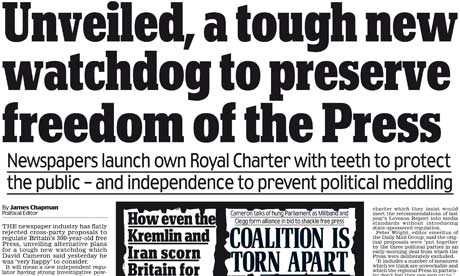
Belatedly, the 3 big parties came to an agreement, and a beefed-up self-regulator, backed by Royal Charter (and with the threat of 'exemplary damages' hanging over any publications who refused to sign up), with no press industry right of veto over the members of the new organisation, was agreed. Notoriously, this was agreed at a meeting that ran into the early hours and included Hacked Off representatives.
 |
| Guardian led on the story |
They also think they've managed to blocked the politicians' hopes of setting up a royal chartered organisation: according to their legal advice, if any royal charter is rivalled or seen as controversial it must be rejected.
The government, and major parties, say they're determined to press ahead.
The press are adamant they won't co-operate.
There is some divide amongst MPs: the influential Tory Chair of the Culture Select Committee, John Whittingdale, has written in the Sun stating he loves their proposal and would back it over the government's.
Its a year and a half since the PCC announced it was scrapping itself. It continues, with its successor still to be settled on.
Who will win this battle of wills and public opinion?
 |
| Sun was blunt in its threat to parliament |
(article created after reading Roy Greenslade's typically sharp analysis, and Lisa O'Carroll's analysis of the likely political response to the press plan: http://www.guardian.co.uk/media/greenslade/2013/apr/26/press-regulation-national-newspapers and http://www.guardian.co.uk/media/2013/apr/29/newspaper-industry-royal-charter-david-cameron)
Tuesday, 26 March 2013
Leveson summary at March 2013
JUNE 2014: This is great to look back at and get a clear sense of what was proposed, and how very, very tame (yet again!) the new self-regulator IPSO appears - where's the power to fine up to £1m that was mooted for example?!
See the post below for a great table on the responses of the 3 big parties; victims and the press to the emerging proposals for a new regulator.
Here, I've copied in a point-by-point FAQ from The Guardian summing up many of the points you need to know to really grasp this thorny issue
Its also necessary to put this into wider historical context, something we'll look at in more detail
See the post below for a great table on the responses of the 3 big parties; victims and the press to the emerging proposals for a new regulator.
Here, I've copied in a point-by-point FAQ from The Guardian summing up many of the points you need to know to really grasp this thorny issue
Its also necessary to put this into wider historical context, something we'll look at in more detail
The press regulation deal – Q&A
Is it statutory regulation, how would the new watchdog deal with phone hacking and what do victims of media intrusion think of it?
 |
The new press
regulations will affect the newspaper industry – including regional
newspapers and news-related websites, and magazine publishers.
Photograph: Paul Hackett/Reuters
|
How will press regulation be different now from before?
Culture secretary Maria Miller has claimed the prospect of investigations, fines of up to £1m for the worst or serial offenders will make it one of the toughest regulators in the world. While the predecessor Press Complaints Commission had no powers to impose fines, it was its lack of independence from newspapers that caused its demise. Its inaction over allegations of widespread phone hacking at the News of the World led it to being branded a "toothless poodle". The new watchdog should be completely independent. The press will have no veto over who sits on the board and serving editors will not be members of any committee advising on complaints, unlike the old system in which editors adjudicated on each other.
Is it statutory regulation or not? (And what is statutory underpinning anyway?)
The new regulator will be established by royal charter, not law. The charter will be entrenched in statute so it cannot be changed by ministers. It could only be amended if there is a two-thirds majority vote in both houses of parliament. The wording, d
Tuesday, 13 November 2012
BBC: editor-in-chief function examined
I'll maybe add notes to this later, but for now here's a short but very useful analysis of the role thats been much cited in news stories over the Newsnight/Lord MacAlpine scandal: whilst usually referred to the Director General, the BBC's top man on the operating side (and it is a very male-skewed team) is also editor-in-chief. The article below sets out clear arguments why this is important; is typical of large media organisations; looks at the devolved responsibility involved - spot on for exam prep + simply for general understanding!
More links?
Odds on who's going to succeed Entwistle - my money is on Ed Richards (if the Tory gov can stomach an ex-Labour man that is)
BBC director general should not be stripped of editor-in-chief role
George Entwistle was not the first BBC chief to fall on his sword for mistakes he had nothing to do with. But the royal charter should not be rewritten in haste during a crisis

 |
A TV crew set up
outside BBC headquarters in London following the resignation of George
Entwistle as director general. Photograph: Alastair Grant/AP
|
It is one of the curiosities of the BBC that its director general is also its editor-in-chief. The secondary job title, only ever remembered in moments of crisis, does foster the unhelpful image of the DG spending half their time wandering around the newsroom wearing a green eyeshade, as well as being chief executive of one of the world's biggest broadcasters.
On that basis, it would be an impossible task. The BBC last week said it produced 425,320 hours of TV and radio output last year – or 1,165 hours a day. And then there's the BBC's considerable online output. No director general, however adept or floundering, can manage to watch more than a tiny fraction; Greg Dyke never heard Andrew Gilligan's report at a few minutes past 6am on the Today programme that sparked the "sexed-up" dossier row with Tony Blair's government in 2003. And apparently George Entwistle paid little attention to last Friday's Newsnight.
The BBC Trust chairman, Lord Patten, told Andrew Marr on Sunday morning there might be a case for looking at the editor-in-chief role and the "relationship between director general [and] editorial and creative". But as the dual job title is written into the BBC's royal charter – not due for renewal until 2017 – it is hard to see how it can be changed. Nor should it be.
The corporation's constitution is not to be rewritten by politicians in haste in the aftermath of a crisis; that would amount to interference. Those who want to argue that the BBC is ungovernable may say shedding the job title is only the beginning of a debate on cutting the size of the national broadcaster.
Those familiar with Patten's thinking are saying he does not want to strip out the secondary job title – his BBC Trust has already looked at that – but perhaps move the BBC closer to the model used at ITV, where there is a chief executive, former Royal Mail Group boss Adam Crozier, and a senior editorial figure, director of television, Peter Fincham.
Anyway, editorial responsibility at the BBC is devolved, not least to Helen Boaden, the BBC News director, and then to the editors of individual news programmes, the Six and Ten O'Clock News, Newsnight and Panorama.
It is those editors who have to take day-to-day responsibility for errors as well as running orders – although, as Dyke and Entwistle have found, when a piece of BBC journalism is as flawed as the Newsnight report, it then does become a problem for the person at the top. The devolution is realistic and necessary; no media organisation would function without it.
Rupert Murdoch likes to read and influence the newspapers at the company he part owns and runs. Some describe him, informally, as the editor-in-chief of newspapers such as the Sun. No doubt he too should have known what was going on at the News of the World. Yet even Murdoch would not describe himself as chief executive and editor-in-chief on his business cards, even though his day-to-day input is far greater than a BBC chief's.
But although the editor-in-chief title for the BBC's leader is flawed, it should not be tossed aside because of editorial failings across BBC News. Newsnight's mistakes were not the product of a job title; in the case of the McAlpine misidentification at least, they were the product of basic errors of journalism. Training and common sense are needed to deal with that.
More links?
Odds on who's going to succeed Entwistle - my money is on Ed Richards (if the Tory gov can stomach an ex-Labour man that is)
Subscribe to:
Posts (Atom)