Showing posts with label 1851 stamp duty scrapped. Show all posts

Tuesday, 30 April 2013

Parliament v press over post-PCC regulator

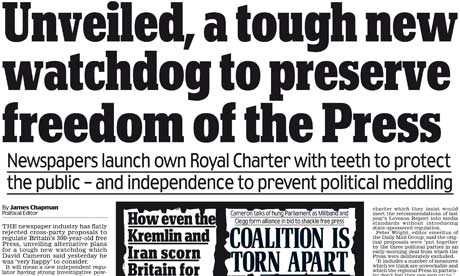
Daily Mail splash on the battle over press regulation
See Media Guardian's press regulation micro-site for lots more news and analysis on this.
So... we initially had the Tories seeking to minimally apply Leveson, backed by most of the press (The Guardian and Indie took a separate line broadly favouring tougher regulation), seeing Cameron, otherwise criticised by the right-wing press for being insufficiently right-wing(!), hailed as a hero defending ancient freedoms.

Belatedly, the 3 big parties came to an agreement, and a beefed-up self-regulator, backed by Royal Charter (and with the threat of 'exemplary damages' hanging over any publications who refused to sign up), with no press industry right of veto over the members of the new organisation, was agreed. Notoriously, this was agreed at a meeting that ran into the early hours and included Hacked Off representatives.

Guardian led on the story
The press were not happy. Are not happy. So ... they've now come up with their own proposals! They reinstate the press' right to veto appointments. They keep a potentially stiff fines system (up to £1m - half of what the parties agreed upon?). They removed the right of parliament to reform this body with a 2/3 majority in the Commons. They argue such a measure would overturn '3 centuries of press freedom', a phrase you'll see used frequently in press coverage (referring to the 1694 abolition of licensing - that sounds better than 150 years (the abolition of stamp duty) which is more commonly seen as the moment when a free press was established, though Curran and Seaton would of course disagree!).

They also think they've managed to blocked the politicians' hopes of setting up a royal chartered organisation: according to their legal advice, if any royal charter is rivalled or seen as controversial it must be rejected.

The government, and major parties, say they're determined to press ahead.
The press are adamant they won't co-operate.

There is some divide amongst MPs: the influential Tory Chair of the Culture Select Committee, John Whittingdale, has written in the Sun stating he loves their proposal and would back it over the government's.
Its a year and a half since the PCC announced it was scrapping itself. It continues, with its successor still to be settled on.
Who will win this battle of wills and public opinion?
Sun was blunt in its threat to parliament

(article created after reading Roy Greenslade's typically sharp analysis, and Lisa O'Carroll's analysis of the likely political response to the press plan: http://www.guardian.co.uk/media/greenslade/2013/apr/26/press-regulation-national-newspapers and http://www.guardian.co.uk/media/2013/apr/29/newspaper-industry-royal-charter-david-cameron)

Tuesday, 29 March 2011

PressHistory1: Stamp Duty [draft]

The orthodox interpretation of the development of the British press has remained unchanged for over a century. ‘The British press,’ writes David Chaney, ‘is generally agreed to have attained its freedom around the middle of the nineteenth century.’ This view, first advanced in pioneer Victorian histories of journalism, has been repeated uncritically ever since.
The winning of press freedom is attributed in part to a heroic struggle against state repression. The key events in this struggle are generally said to be the abolition of the Court of Star Chamber in 1641, the ending of press licensing in 1694, Fox's Libel Act, 1792, and the repeal of press taxation - the soc-called 'taxes on knowledge' - in the period 1853-61. Only with the last of these reforms, its is claimed, did the press become fully free.
It is also argued that the market development of the press contributed to its emancipation. Indeed, some researchers place greater emphasis on this than on the fight against restrictive laws. ... The growth of newspaper profits, largely from advertising, supposedly rescued the press from its compromising dependence on state or party subsidies.
... Orthodox histories of the press, with their stress on the free market and legal emancipation as the foundations of press freedom, provide a powerful, mythological account with a political moral. [p.3]
This narrative, or discourse, of history remains relevant today; it continues to shape and influence the way our media is regulated:
...the Peacock Committe, appointed by the Thatcher government to investigate funding of the BBC - retold the history of the dismantling of press censorship as a prelude to arguing for the eventual removal of all broadcasting regulation (which it equated with 'censorship'). In effect, it deployed a particular view of newspaper history to advocate the reconstruction of television along the free market lines of the press. [C+S 2010:4

Research resources*:
(1) http://www.historyhome.co.uk/peel/social/unstamp.htm
(2) http://www.medialens.org/articles/the_articles/articles_2002/mj_fourth_estate.html
(3) http://m.friendfeed-media.com/b3ba13c4c6809d607b58d4136cf69b7d730134e5 - Chapter 3 (limited page views; this is 6th ed. of C+S book)
(4) https://www.history.ac.uk/reviews/review/528 - scroll down about 2/3 of the way to find: 'Finally, in this section of the book, Hampton discusses two issues in which the educational ideal played a major role: the abolition of stamp duty and the argument about anonymity in the press.'

*search strategy: 'press stamp duty' turned up lots of hits on housing stamp duty; I added 'Curran' to the search and results were much more relevant