Showing posts with label propaganda model. Show all posts

Saturday, 14 April 2018

CHOMSKY SYRIA propaganda model in effect

28 and 7 years ago, with the 8-year Gulf War 2 starting in between 15 years ago, we got classic case studies of the propaganda model in full effect. From the neutral-by-law BBC to the 'centre-left' Guardian in the UK, and across the US media (and every one of Murdoch's huge global empire of newspapers) government military action in the middle east, launched without UN legal approval, received supportive coverage. Huge public anti-war demonstrations received minimal mainstream coverage.

Chomsky himself has spoken at length on how the (then threatened) attack against Syria fitted his model (easy enough to find from a simple search). The alternative news media paints a very different picture from the mainstream, mass media of the UK, US, French and Israeli bombings.

Here's two contrasting examples, one unpicking the rhetoric of coverage in major US and UK media, the other a piece from The Guardian, whose centre-left readership will be broadly hostile to military action abroad (but seen as persuadable if it's for 'humanitarian' causes), and certainly hostile to the Tory PM who is uncritically quoted at length (source strategies) until the end of the lengthy article when Corbyn's objections are mentioned.

'No alternative': Theresa May sends British jets to join air strikes on Syria https://www.theguardian.com/world/2018/apr/14/theresa-may-britain-air-strikes-syria-chemical-weapons-raf?CMP=Share_AndroidApp_Blogger

https://www.filmsforaction.org/articles/major-papers-urge-trump-to-kill-syrians-risk-world-war-iii/

Sunday, 26 February 2017

WEB 2.0 Media giants faking online following

A bizarre but significant twist - with pressure to show a strong online footprint growing in relation to declining print and linear viewing figures, it seems falsely boosting the numbers may be a common strategy. (see yournewswire)

There is much dispute over how papers calculate online readership, and similar arguments over online viewing figures (with YouTube's changing policies seeing huge drops in published figures for many channels and uploads).

According to one source at least the mainstream corporate media have also engaged in using specialists to set up 100s of 1000s of fake social media accounts to create a false sense of engagement ... AND to campaign against their critics, something that Chomsky and Herrman's near 40 year-old classic, Necessary Illusions, with its radical propaganda model, would recognise as flak (one of the five filters they argue systematically removes counter-hegemonic content from mainstream media discourse, or at least undermines it).

Saturday, 18 June 2016

China - state censorship by the book

More examples of what authoritarian media regulation looks like - useful to bear in mind to balance out any attacks you want to make on Western censorship. Chomsky, of course, argues that ownership, advertiser power etc (the five filters) perform the same job less controversially for the hegemonic forces who shape 'our' supposedly democratic media.

China bans news coverage of Hong Kong bookseller abduction.

Sunday, 22 February 2015

Advertiser power and Daily Telegraph HSBC scandal

IN BRIEF: The Daily Telegraph's Chief Political Correspondent resigned, claiming the paper's management spiked a series of critical articles on HSBC rather than lose out on the extensive advertising revenue from HSBC; HSBC had previously made a clear link (see Greenslade and others below) between a paper's coverage and continued advertising 'support'. The nature of the billionaire Barclay brothers' ownership comes into this, as do questions of the role of the press/media in a democracy. The case gives backing to long-established critiques of some Marxist academics who have analysed the impact both of conglomerate/billionaire ownership and the de facto licensing power of advertising (cf. 60s Times, 50s Observer, 00s Mirror and NoTW cases). [YOU CAN FIND A TASK OUTLINE HERE]
Who's this Peter Oborne chap?
Peter Oborne is the hero of the piece. Who is he? An avowedly right-wing 'chief political commentator' for the Daily Telegraph (although Greenslade, a target himself of Oborne, notes that Oborne doesn't always follow the right-wing playbook: criticising the pro-Israel lobby, praising(!) Ed Miliband, supporting the Human Rights Act...). He resigned in disgust at the paper allegedly blocking negative reportage of HSBC, the subject of recent revelations about its efforts in facilitating tax avoidance.

The Telegraph, lets be clear, angrily deny doing any such thing. (Or do they? 'The paper’s editorial on Friday, an illogical mix of bluster and obfuscation, appeared to accept that the breach had occurred.')


Read more - Grauniad/Greenslade bias?
BBC's coverage is less extensive but useful
The fallout from this continues - so look to read more on this, don't just depend on this post (written a week into the scandal on 22.2.15)! With Roy Greenslade following this closely, theguardian.com/media/dailytelegraph is a good source to use - you can decide for yourself if you think the potential benefit of doing down a broadsheet rival, or the left- v right-wing aspect of this are problematic with this coverage. I've used extracts from several, but I've also benefit of reading every article in full - you could too! The Indie doesn't boast quite as good a line-up, but has some quality media coverage (The Times is behind a paywall).
The BBC is a good alternative, though you'll need to do a search such as 'BBC telegraph oborne' to find articles; they don't make it so convenient to find linked articles.


Does This 'Prove' Curran + Seaton/Chomsky's Point?
Curran and Seaton, as well as Noam Chomsky, have plenty of critics who dismiss their analysis as the frothing of lefty, indeed Marxist thinkers. Both have argued that advertisers exercise a de facto licensing system over newspapers, and wider media, and that advertiser preferences invariably mean that radical, counter-hegemonic (yes, Gramsci) content is marginalised. This is hardly a controversial view within Media Studies, but can hardly be considered as mainstream thinking beyond this academic field. Free market advocates would simply counter that the public gets the media content and outlets it wants through the market mechanism.


Tele deny Oborne's claims; condemn reportage of story; attack News UK [Murdoch press] as worse!!!
As the BBC reported,
The Daily Telegraph has published an editorial saying it "makes no apology" for its coverage of the HSBC tax scandal. 
Indeed, part of their response has been to condemn the BBC and Guardian for inventing this story, and even managing an attack on Labour/Ed Miliband! [source: PR Week]
In a promise to its readers published last night on its website, the newspaper makes no apology for the way it has handled allegations made against HSBC – allegations that were "so enthusiastically promoted" by certain media outlets.
The statement questions the editorial impartiality of the BBC, The Guardian and The Times over their dismissive response to MPs' expenses claims, which was revealed by The Telegraph in 2009.
The article then launches an attack on the Labour Party, accusing Ed Miliband of jumping on the HSBC allegations and using them as a "weapon against the Conservatives" to further fuel Labour's "deep-seated hostility to business".
The Tele was bullish in its initial response (PR Week article)
They then went on to attack News UK (Murdoch's newspaper operation) for causing the suicide of two advertising workers in their operation:
The Daily Telegraph has published an anonymous story on its front page suggesting that two suicides at a rival newspaper could be connected to pressure to hit commercial targets, days after its chief political columnist quit alleging that editorial decisions on the Telegraph were being influenced by commercial decisions.The article, which appeared on the bottom of the front page of the paper with the byline “Daily Telegraph Reporter”, said News UK, which publishes papers including the Times and the Sun, had launched an internal investigation into the deaths.The article claims there are “fears that staff are being put under unreasonable pressure to hit targets” in its commercial department. In an article on Friday night, Buzzfeed UK reported a source at the Telegraph saying: “I don’t think any journalist at the Telegraph agrees with what’s going on at the moment.”On Saturday, it published an update based on further contacts with Telegraph staff, who it said were “disgusted and bewildered” by the story’s publication. It added:
Three individuals with knowledge of the newsroom claimed the reporter who wrote the anonymous piece did not bring in the story themselves but was given it to write by their superiors at the newspaper. One source in the newsroom saw the reporter arguing with the news desk over the story, while a second described a newsroom culture where journalists could not veto stories they did not want to write.
(Dominic Smith, Guardian, 21.2.15)


Wider than HSBC coverage: Despicable Me 2, China, Russia...
Newsnight (BBC2's flagship news show) editor wrote a feature for the BBC on this issue summing up their findings:
Daily Telegraph journalists have said they felt discouraged from writing uncomfortable stories about a range of advertisers and commercial partners.
These included the governments of Russia and China, a film distributor and RBS, BBC Newsnight has learned.
Somewhat bizarrely (but thus memorably!) Despicable Me 2 has been drawn into the row, with the original 2-star rating upgraded to 3-star after the distributors bought extensive advertising for the film.

So ... is this corrupt practice endemic to our press? The role of circulation decline
Lets be careful about assuming or accepting that this practice is limited to the Tele alone - all papers are suffering the double-barrelled impact of circulation decline, as older readers die off without many newer readers taking their place and advertising revenue (along with readership) migrating online; many of the previous mainstays of press ad revenue have been largely lost to online rivals, while their websites generate a lot less per reader than the print editions.
We've just seen the Mirror hold its hand up and acknowledge it has been guilty of phone hacking, a practice popularly associated with the Murdoch tabloids, so lets not assume it is just the Tele indulging in this.
As ever, Greenslade has interesting comments on this. He is scathing on the Tele's editorial:
“We are drawing up guidelines that will define clearly and openly how our editorial and commercial staff will co-operate in an increasingly competitive media industry.” Rival publishers could have been forgiven for laughing out loud. No national newspaper owner has previously thought it necessary to codify one of the key planks that maintains a newspaper’s credibility. Despite threats from advertisers, editors revel in the opportunity to show they cannot be bought.
He notes examples of editors standing up to valuable advertisers:
When Distillers pulled its advertising from the Sunday Times during its 1960s campaign on behalf of thalidomide victims, the editor, Harold Evans, was supported by his advertising chief. Years later, when the Sunday Times had passed into Rupert Murdoch’s hands, Mohamed al-Fayed threatened to remove £3m of Harrods advertising from the paper because he didn’t like an article about his renovation of a house in Paris. Its then editor, Andrew Neil, turned the tables on him by telling him he was banning him from advertising, a move enthusiastically endorsed by Murdoch.
He gives another example from 1984 of a freelance scoop on BT, which was undergoing privatisation and spending a fortune  on associated advertising, being at first taken up then spiked by both the Mail and then the Express.

60s Times; Chomsky's filter; ad boycott campaign kills NoTW
So, having looked at how the narrative of press freedom through deregulation and government withdrawing from the press industry can be re-written as a cynical exercise in ensuring the "right people" were in control of the press (a phrase commonly used in contemporary Parliamentary debate over repealing stamp duty on newspapers); the 1960s case of The Times being compelled by unimpressed advertisers to ditch its new working-class (or C2DE) readership; Chomsky's contention that (dependency on) advertising operates as one of the five filters of the 'propaganda model'; and the extraordinary reaction of one of the world's most powerful media groups when advertisers, threatened by a series of Twittersphere boycott campaigns, began to pledge to withdraw all advertising from the NoTW ... now we have an even clearer, even more recent example to utilise. Ian Jack (below) adds a further historical example he claims shows the long-term and continuing impact of advertising preference: the decline of the Observer, once the dominant Sunday quality paper.


Suddenly, the press wakes up to its own elitist, hegemonic nature?!
This seems to have sparked critical comments the likes of which are rarely witnessed in our press about our press, such as Owen Jones' opening paragraph:
By and large, Britain does not have a free press. Our media is not run by the government, and nor does it engage in widespread censorship. Instead, the media is run by a tiny group of politically motivated moguls, themselves in league with other private interests through advertising or personal networks. Journalists from non-privileged backgrounds are filtered out through unpaid internships and expensive post-graduate qualifications, ensuring the media is a closed shop for the well-to-do. According to a report published by the Social Mobility and Child Poverty Commission last August, over half of the top 100 media professionals are privately educated. News coverage all too often reflects the priorities, concerns and prejudices of this tiny sliver of the British population. Rather than being a means to hold the powerful to account and fairly report issues, the media is the ultimate political lobbyist for our elite.
('Peter Oborne's resignation shows that the media shouldn't just serve the rich', 20.2.15, Guardian)

Ian Jack: Observer slumped after advertisers rejected its 1950s radicalism
Ian Jack provides an interesting perspective, attacking his own profession for the haughty disdain with which they've (and he includes examples of his own behaviour) held the advertising section that financially underpins the editorial enterprise. He gives as an example of how the Observer suffered by alienating advertisers: being seen as too radical in the 1950s (Jack argues) led to the Sunday Times overtaking it in circulation and advertising. The Observer had strongly condemned the 1956 British invasion of the Suez (cheered on by Israel), leading to condemnation in parliament and other media. You may see a strong parallel here with Piers Morgan's editorship of the Mirror, brought to an end over his strongly anti-Iraq War line.
“Patriotic” British companies wanted nothing to do with such an apparently treasonous paper; English Electric was still refusing to advertise in it 10 years later. Also, as Astor later wrote, “the loss of Jewish advertisers was very marked”. The paper had always been supportive of Israel, and according to Astor, had a higher proportion of Jewish readers than most newspapers; now the Observer’s implicit criticism of Israel for its part in the operation “caused the strongest possible agitation among Israel’s supporters”....In commercial terms, morality didn’t serve the Observer well. Its anti-apartheid stance sent South African advertisers elsewhere, and only in 1958 did it lift a ban on alcohol (with a decorous advert for dry sherry) after research showed that strong drink provided the Sunday Times with an extra 29 columns of advertising, enough to give it a four-page advantage over its rival. Today the Sunday Times outsells the Observer four-to-one. You can argue the merits of their journalism – which has the livelier, the better written, the less vulgar, the more politically appealing – but the roots of their relative success and failure lie in decisions made by newspaper advertisers 60 years ago. The reach is very long.
('Reporters hold their noses about advertising in newspapers. But history shows the risk that purists take', Guardian, 20.2.15)

Jenkins
Simon Jenkins often seems to be a right-winger placed in the Guardian to provoke that all-important reader/user interaction, and I note below a counter to his arguments in his column on the Tele. He makes a variety of useful, insightful points here:
HSBC had stopped advertising in the Telegraph in 2012 over a similar story to the Guardian’s, about tax evasion in Jersey, and the management was frantic to see revenues restored. In other words, HSBC was not just illegal and unethical but also a bully. The Guardian also recently had its HSBC ads “paused”, but declined to yield. That HSBC was chaired by an Anglican priest who took the government shilling as an ennobled minister merely illustrates the many-splendoured architecture of the British establishment.An American newspaper is said to have carried the ironic motto “As independent as resources permit”. Any student of the press knows what this means. A business page protocol ordains gentle treatment of proprietorial interests. Fashion pages would not exist without kickbacks, or travel pages without “contra” deals on hospitality and mentions. I remember perfume firms threatening to withdraw ads after stories on animal cruelty.
So, there is a certain degree of shamelessness in other papers clamouring to attack the Tele, a fair point.

He notes a famous, notorious even, example of the Murdoch press being muzzled to aid his wider empire's ambitions - he doesn't mention how Harper Collins pulped the hardback copies of Hong Kong Governor Chris Patten's memoirs, for which he'd been paid a 7-figure advance; or how the BBC was kicked off Star, News Corp's Asian TV network, both seen as being to protect Murdoch's prospects of doing business in China. He does tackle this though - and get in a dig at his own sainted paper too:
Rupert Murdoch was robust in backing investigative reporting at Times Newspapers, especially on the Sunday Times. He did so to a fault in the case of the phone-hacking News of the World. But his Times undoubtedly restrained its China coverage when he was struggling for a media deal with Beijing.Even the Guardian cannot be regarded as immune from such pressures. In March 2007 Labour’s short-lived Pathfinder scheme, involving dire housing demolitions in the north, was inexplicably eulogised in a Guardian supplement in return for an undisclosed payment from the government. Today its “branded content partner zone” is occupied by Unilever, “whose sources of revenue allow us to explore, in more depth than editorial budgets would otherwise allow, topics that we hope are of interest”. Hence this week’s frothy promotion, under the Guardian masthead, of a “green sex sustainable” condom – though it’s also fair to point out that the Guardian columnist George Monbiot launched a withering attack on the partnership in these pages.
If you read papers you advertorial

Prof. Brian Cathcart rubbishes Jenkins... Prof. Horder cites Bribery Act
Cathcart has written some key books on the press; he wasn't impressed with Simon Jenkins' arguments, and wrote a letter to the Guardian to say so...
Newspapers are a medium of information and if the information is false the reader is duped. Jenkins suggests that plurality protects us, yet with a few exceptions our national press operates as a cartel, papers covering up each others’ faults. The result is that uncorrected lies pile up in our public space, polluting debate and warping policymaking.
Two other points. As Oborne reminds us, newspapers have “a democratic duty to tell readers the truth”, and, as Leveson reminds us, they have an obligation not to “wreak havoc in the lives of innocent people”. These are responsibilities. Sadly, the corporate press refuses to take responsibility for anything.
Professor Brian CathcartKingston University London
On the same letters page, a (law) Prof. Holder argues that the Tele's actions, if true, might constitute a crime under the 2010 Bribery Act, a useful reminder + example: wider law fills in a lot of the gaps for the seemingly deregulated press.

Friday, 13 February 2015

Ownership, Accuracy and Press Power


TASK: In the 5:10 it takes this video to play, make brief notes on examples of a Chomskian concept that this video illustrates and the song lyrics specifically mention...

This is a case where the terminology essentially is the EAA, or at least a starting point for it. Use one of the following to find relevant EXamples (the egI give use the Daily Mail and Ed Miliband; you don't have to use these):
  1. You could try searches such as '2015 daily mail miliband' (the 2015 gets recent results: eg), 'daily mail miliband press regulationetc (what specifically did the Mail do to try to discredit 'Red Ed' Miliband when he was pushing for a tough press regulator?);
  2. You could gamble on a quick browse of the Daily Mail, the most likely source...
  3. You could try the appropriate MediaReg blog tag
Please don't click on 'read more' until asked to


Tuesday, 20 January 2015

Balanced broadcasters? Don't bank on it...

Our ‘impartial’ broadcasters have become mouthpieces of the elite http://gu.com/p/453g6

This is a piece by columnist George Monbiot, a prominent left-wing environmentalist (who can be seen in one of Russell Brand's regular YouTube videos); he argues:
The illusion of neutrality is one of the reasons for the rotten state of journalism, as those who might have been expected to hold power to account drift thoughtlessly into its arms.
He details a scandal at the Canadian equivalent of the BBC before examining the BBC's highly partial, biased reportage of the economic crisis and the austerity policy that our three major parties have all agreed upon. As you read this, consider that Chomsky's propaganda model has 'source strategies' as one of the five filters, with flak (for any foolhardy enough to question austerity) also an issue here, alongside the anti-Communism (i.e., anti-left-wing) filter too:

Thursday, 5 June 2014

WIDER ISSUES: Privacy

This is a topic I've frequently blogged on - use the tag cloud to find previous posts.

There are two ways to view the issue of privacy as it applies to media law and regulation:

  1. There should be tougher, tighter restrictions on the media's ability to invade our privacy, as tabloid newspapers in particular persist in doing so on flimsy grounds
  2. We urgently need to liberalise privacy law in favour of the media, as it is becoming increasingly difficult for UK media to publish information about the rich and powerful (those with access to expensive lawyers)

As ever, there are overlapping issues with digitisation:

  • UK-only privacy regulation/law is made absurd by the easy access to global online resources
  • As most of us permit websites and apps to track huge amounts of personal information about us, we increasingly undermine the argument that we have a right to privacy

There are cases from the press, TV and film that we can consider, but there is a further point we swiftly encounter, for example through the Max Mosley case:

  • Media regulation of single industries makes no sense, and is ineffective, when there is so much cross-media ownership


Secret Terror Trial = end of Fourth Estate?

There are various terms used below: fourth estate, public sphere, superinjunction, statutory regulation, concentration of ownership, liberal pluralism, Marxist critique: (Chomsky's) propaganda model, hegemonic, free market, web 2.0.

The media are regulated because (a) they are seen as having profound influence on social psychology, values and attitudes and (b) because they are seen as a basic, fundamental part of a functioning democracy. Of course, the democratic function leads some to argue that we shouldn't regulate the media - or, more specifically, that the government shouldn't have a role in this; this is a key argument used against tougher, statutory regulation of the press.

June 2014 sees news emerging of a criminal trial which the media were originally banned from reporting on, including on its very existence. The very concept of a fourth estate (or free press, where press doesn't just mean newspapers) is based on the idea that the media will hold governments and big business to account, and expose any corruption, improper or antidemocratic practices.

Friday, 16 November 2012

Press anti-Leveson FLAK (Chomsky concept)

There are many articles you could find which will demonstrate the typically partisan, subjective approach of the bulk of the UK press to Leveson, in the key period between the end of the public hearings and his report, which will recommend how the regulation of UK media should be reformed.
I've copied in just one below, an unusually belicose missive from Grauniad media blogger Roy Greenslade, but it provides specific detail of the flak strategy with specific examples, plus further links.
Flak is one of Chomsky + Herman's five filters within their propaganda model of how the media operate, and to what end (not to inform a citizenry but to reinforce support for elites). You'll find multiple links to Chomsky here and on the prodeval blog.

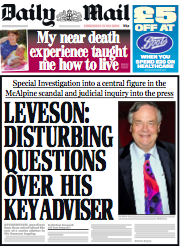
Laughable Daily Mail 'investigation' smears Leveson inquiry assessor

I have been worried about the Daily Mail's editor, Paul Dacre, for some time. After seeing today's issue of his paper, I really think it's time for the men in white coats to visit its Kensington offices as soon as possible.
The Mail devotes 11 full pages, including the whole of the front page, to a "special investigation" into one of the Leveson inquiry assessors, Sir David Bell.
maiIt seeks to present Bell, the former Financial Times chairman, as the spider at the centre of a web of intrigue. In a classic example of conspiracist innuendo, it implies that the "elitist liberal" Bell is covertly exercising influence that somehow threatens the freedom of the press.
He is presented across many thousands of words as some kind of shadowy figure who, through his chairmanships and trusteeships of various charitable bodies, is exerting undue and unaccountable power.
Through a series of leaps of logic and phoney "revelations" of Bell's publicly acknowledged positions, the articles persistently insinuate that he has been up to no good.
He is even accused of being somehow responsible for the Newsnight report which falsely suggested that Lord McAlpine had been guilty of child abuse and, by extension, that he is also part of the reason for the BBC's current crisis, including the resignation of its director-general.
In a leading article, the Mail says its "investigation paints a picture of how a small, intertwined nexus of Left-of-centre individuals – some with links to Ofcom, the media regulator, and virtually all with links to Bell – have sought to exert huge influence on the inquiry."
Clearly, this is a sensitive time to attack a member of Lord Justice Leveson's team, as the editorial admits:
"The Mail is acutely aware of the seriousness of publishing this investigation. We know all too well that our enemies will accuse us of being aggressively defensive in a bid to pre-empt the outcome of the Leveson report, which is due any week now.
But in the light of the scandal engulfing the BBC, we passionately believe in the public's right to know about a senior Leveson assessor's role in it."
So, in order to lend some sensible perspective to this astonishing accusation about Bell's supposed complicity in the BBC's "scandal", let me try to disentangle what amounts to a farrago of distortion with added vilification.

Tuesday, 15 May 2012

Free market ideas and broadcast regulation

Free market ideology centres on the belief that state interference in (ie regulation of) business and 'the markets' is negative and will harm business interests and economic growth. This is central to the right-wing ideology, though all three of our major parties today, including the supposedly left-wing Labour, follow this ideology.

This is also the dominant ideology of our press: 6 of the 9 main national dailies are right-wing.
The classic narrative or history of press regulation centres on one key point: that we only gained a free press when free market conditions were introduced; the ending of the stamp duty, in creating a free market, finally meant that the press were truly independent from government and politicians, and could now fulfil the central democratic role of a 'fourth estate' holding politicians and governments to account.

Curran and Seaton (and Chomsky and Herman, with their propaganda model) argue this is an intentional misreading of what actually happened - and what was intended to happen. They argue that this supposed 'free market' was explicitly designed to favour right-wing views, quoting from parliamentary debate to evidence this (politicians of the time were explicit in their aims to prevent or discourage the poor/working class from reading or publishing newspapers, and doing everything possible to stymie the then-healthy and strong radical, leftist press). Advertisers became the de facto regulators of this 'free market', and remain so today, with rising production costs meaning that only the wealthy could aspire to publish a newspaper (today, it would cost close to £100m to launch and fund a new national daily paper for a year).

Despite this, broadcasting regulation was initially very strict: after the BBC's monopoly was broken with the creation of ITV, the scheduling and programming of ITV was very, very tightly controlled by the regulators (ITA, then IBA) who had a hands-on role that is scarcely imaginable today. The regulators acted like channel managers would today, intervening if they didn't like the scheduling or mix of programmes.

Although Thatcher would famously rig the free market to punish an ITV company (Thames) that dared to defy her and introduce strict censorship laws over the issue of coverage of Northern Ireland (the 1988 Broadcasting Ban), her election in 1979 marked the start of a gradual dregulation. Thatcherism centred on free market beliefs, and piece by piece, continued by Labour, broadcasting regulations would be relaxed, and the restrictions on ITV companies (their ability to merge, plus PSB requirements) were relaxed. The ITC would be launched as a 'light touch' regulator, and OfCom was explicitly introduced with a core aim written into its own regulations of deregulation. In both cases, the idea of creating a 'national champion' capable of competing with US conglomerates was cited as a key factor.

There have been a few bumps along the road, however: much to the outrage of the Tories in Opposition (ie when Labour were in government), OfCom expanded its role to launch its own investigations and suggest new legislation on a wide range of media issues, while the 1986 Peacock Report famously shocked Thatcher by failing to recommend privatisation of the BBC, or scrapping the license fee in favour of ads.

Wednesday, 6 April 2011

Chomsky Gramsci Baudrillard

(to be adapted)

We're going to critically examine a number of media theories as we work through both parts of the A2 exam (you will also have to apply these to your own coursework).
Three fairly familiar names to kick off:
NOAM CHOMSKY
ANTONIO GRAMSCI
PIERRE BOURDIEU


CHOMSKY + HERMAN'S PROPAGANDA MODEL (5 FILTERS)
Chomsky, a linguist, has contributed a lifetime's analysis of how the media functions, but his key contribution remains the 'propaganda model' formulated with Edward Herman (forgive me if I say Bernard Herrmann occasionally, thinking of the great movie composer behind the Psycho score and many, many others).

First presented in their 1988 book Manufacturing Consent: The Political Economy of the Mass Media, the "Propaganda model" views the private media as businesses interested in the sale of a product — readers and audiences — to other businesses (advertisers) rather than that of quality news to the public.
The theory postulates five general classes of "filters" that determine the type of news that is presented in news media. These five classes are:
  1. Ownership of the medium
  2. Medium's funding sources
  3. Sourcing
  4. Flak
  5. Anti-communist ideology*
The first three are generally regarded by the authors as being the most important.
Although the model was based mainly on the characterization of United States media, Chomsky and Herman believe the theory is equally applicable to any country that shares the basic economic structure and organizing principles which the model postulates as the cause of media biases.
 [Source: wiki]    *DB note: the theory was created at the height of the Cold War, with 'the West' in a conflict with the Russian-dominated USSR (most of Eastern Europe, plus some other nations such as China); this was essentially two competing ideologies: capitalism (right-wing) v communism (left-wing). The 5th filter today really means anti-left-wing, not necessarily anti-communist

You should be able to see how ownership (specifically concentration of ownership) shapes British cinema from the AS unit. Ken Loach's films Hidden Agenda and The Wind That Shakes the Barley are useful to demonstrate the operation of flak (a metaphor based on bullets shot at aircraft over a wide area, known as flak - in this case its radical, typically left-wing, ideas which are effectively shot down through hostile media coverage).

Could you put a name to the following three folks?

Bloody Sunday flak flies

[cross-posted from another DB blog]

Perfect article from Roy Greenslade (whose work is worth browsing through for more great examples of analysis of the national press) to illustrate not only how events such as the Bloody Sunday killings, and the wider 'Troubles', have undermined positive representations of the Army upon which much of our collective British identity had been built, but also flak...
Before reading the article, ask yourselves which papers you might expect to be hostile to calls for British soldiers to be prosecuted for what is now legally recognised as murder of unarmed civilians; which, if any, might be supportive of this call? (If you want to get really sophisticated, one of the two most likely, as a left-wing leaning paper, to support calls for prosecution gave little coverage to the story - perhaps ever since they took the brave decision to campaign against the invasion of Iraq, and got incessant flak from much of the media, they no longer have the will to take up controversial causes? Clue: Piers Morgan was their editor, sacked as sales fell and for the scandal around a doctored photo they used on the front page)
Chomsky's propaganda model says that you can predict how the media will react to certain types of stories, with five filters dredging out the content that might be critical of our ruling elites (reflecting Marxist theory). Switching to film, remember Hennebelle's argument that even when we do get seemingly counter-hegemonic political films, they don't actually really critique the system, but rather argue that it will be fine if we just weed out the 'bad apples'.
Anyway, back to Roy...


Bloody Sunday: How the press greeted Saville's report


Daily Mail - 16 June 2010
The Daily Mail front page

The prime minister said sorry for Bloody Sunday yesterday. Through gritted teeth the former head of the army, General Mike Jackson, also apologised.
Unsurprisingly, given its content, the story of Lord Saville's report exonerating the 13 victims of 1 Para on that terrible day in 1972 dominated the television news throughout the day.
But how have today's newspapers reacted? All the serious papers have given it big front-page treatment with plenty of coverage inside.
The Times (splash: Cameron seeks closure as he says sorry for Bloody Sunday) carries five full pages plus an opinion piece by Danny Finkelstein, a leader and a clever Peter Brookes cartoon.
The Daily Telegraph (front: Cameron apology for Bloody Sunday) gives it four pages inside, a comment by former chief of general staff Sir Richard Dannatt, a leader and cartoon.
The Independent (front: Truth and reconciliation) carries 10 pages, which includes commentaries by Robert Fisk and the Irish actor James Nesbitt. In its Viewspaper section, there is an article by Henry Patterson,a leader and cartoon.
The Guardian (front: 38 years on, justice at last) devotes six pages inside plus an opinion piece by Jonathan Freedland, a leader and a cartoon.
The Financial Times carries a page one picture with a cross-ref to a page inside plus a piece by John Lloyd and a leader.
In terms of quantity - and I'll come back to the content in a moment - this was to be expected. The papers' treatment reflects the seriousness of the topic and therefore fulfil a public interest.
Now let's look at the populars, starting with the Daily Mail. Its page one (True face of our soldiers) is a rather convoluted "take" on Saville, seeing it through the prism of deaths of troops in Afghanisation. There are six further pages inside, which include a Max Hastings comment. There's also a leader.
The Daily Express has front page room only for a blurb and a mere two pages inside plus a short leader.
The Sun manages a couple of front page paragraphs turning inside to just one page, plus a leader. The Daily Mirror doesn't even think it merits page one treatment, giving it two inside pages and a leader. Mind you, that's a great deal more than the Daily Star, which carries only page two story.
OK, what do the papers think? There is a clear theme in most of the leading articles. Though accepting of Saville's findings and sympathetic to David Cameron's response to them, they wish to draw a line under the affair. There should be no legal action against the soldiers who murdered 13 unarmed innocents.
The Times, acknowledging the lack of justification for the murders, concludes: "To prosecute individual soldiers would only compound injustice."
The Telegraph's leader headline is unequivocal: Prosecutions would be in no one's interest. It says: "Without diminishing the suffering of the bereaved or seeking to exonerate any of those criticised, it cannot be in the interests of the victims, their relatives, the people of Northern Ireland or of the United Kingdom to pursue this through the courts. This tragic chapter should now be closed."
The Independent agrees, arguing that "it would be best" if the Northern Ireland DPP "let matters rest, and avoids wearisome legal proceedings which might well not result in convictions. The Saville report cleared the dead of Bloody Sunday and said that what the Paras did was unjustified.
"It should suffice if dignified expressions of regret are voiced, healing efforts made and perhaps compensation offered... Since these are finally on offer, a start can be made to consigning Bloody Sunday to history."
The FT, in its leader, Truth at last about Bloody Sunday, agrees about compensation. Contending that Saville's inquiry "elided an inquest with a prosecution", it says: "The lapse of 38 years, make prosecutions problematic... For now, the UK state has apologised. The Parachute Regiment should follow, as should compensation for these unlawful killings."
But The Guardian alone, in Derry's moment of truth, urges prosecutions.
If it kills its citizens, the state and its servants must answer for their actions. Saville's findings are part of that process. But the cases must also be properly examined by the prosecution authorities.
If the evidence permits, which at this distance it may not, those who killed the innocent in Derry in 1972 should be prosecuted. No amount of political convenience should be permitted to stand in the way of justice.
The Sun takes a polar opposite view: "Nothing will be achieved... by dragging soldiers into court 38 years on. We emptied the prisons of IRA murderers as the price of reconciliation after the Good Friday Agreement. How could we jail squaddies after freeing IRA killers?"
The Express is also against legal action: "British soldiers must always expect to be held to higher standards than terrorists. But it is difficult to see how bringing criminal prosecutions against the retired paratroopers involved could possibly be in the public interest."
Surprisingly, the Mirror is agnostic on this key question. It restricts itself to saying that "the atrocity is a horror story which had to be told.
The Mail is the most critical of the report, saying "we are slightly mystified" as to how Saville can be so certain that the Paras shot first, without warning or provocation.
It complains about the cost of the inquiry and its longevity but it does not deal with the rightness or otherwise of prosecuting the soldiers.
Its columnist, Max Hastings, is even more critical in his polemic, This grossly misguided excavation of the past. "Only Britain," he writes, "could have been so foolish as to allow an inquiry into 14 selected deaths during the Troubles which killed 3,526 people to become a 12-year black comic saga which has cost almost £200m."
He continues: "It may be true that this report offers an approximation of the truth, but it would be absurd to place unlimited faith in findings based on evidence gathered so long after the event."
And he concludes: "If there is now any hint of prosecutions, there will be just public outrage, when hundreds of Republican and Protestant killers walk free, and some indeed draw pay as MPs.
"David Cameron has responded to Saville with a fine combination of honesty, dignity and regret. We should all hope that this tragic fragment of history now gets decent burial."

Tuesday, 22 March 2011

BBC Panorama doc on phone-hacking: how to apply for exam [DRAFT]

PANORAMA DOC "TABLOID HACKS EXPOSED" on iPlayer

Theories: Philip Schlesinger's "source strategy" + Chomsky's "propaganda model", particularly the "five filters" ... not least flak (this p.m. is a key theory we will return to repeatedly)

MORE READING:
MEDIA DIGEST: Times attacks Panorama over phone-hacking allegations
ROY GREENSLADE BLOG [MEDIA GUARDIAN]: The Times throws mud at the BBC to play down phone-hacking revelations
PANORAMA DOC "TABLOID HACKS EXPOSED" on iPlayer
BBC WEB DISCUSSION ON DOC - note the banned comments!
The MURDOCH Empire and its Nest of VIPERS [blog, covers the story]