Showing posts with label free press. Show all posts

Friday, 9 February 2018

LEVESON buried as government goes for Google

UPDATE: Former Labour Leader Ed Miliband (or 'Red Ed' as the right-wing red-tops would have it of this very 'centrist', at least politician who opposes Jeremy Corbyn's left-wing policies) has called for Leveson2 to happen.
Great quote on IPSO - he wasn't impressed when the Mail branded his father a traitor. He tweeted and gave media interviews to counter that rather than trying IPSO.
The Leveson inquiry must be completed. The victims of phone-hacking deserve nothing less

https://www.theguardian.com/commentisfree/2018/may/08/victims-phone-hacking-leveson-inquiry?CMP=Share_AndroidApp_Copy_to_clipboard

UPDATE2 A vote could back Impress as the compulsory regulator, and another make papers pay legal costs whether they win or lose any case.  
Government faces possible defeat on press regulation votes

https://www.theguardian.com/media/2018/may/08/government-facing-possible-defeat-in-press-regulation-votes?CMP=Share_AndroidApp_Copy_to_clipboard

Nor can we take comfort from the response to Leveson part one. The press declined to set up the kind of independent regulator that both Leveson and parliament wanted to see. Instead we have Ipso, a toothless organisation that, despite bold promises, has yet to impose a single fine or deliver a single equal prominence front-page correction in a national paper. There are also significant issues around the lack of rules or redress around much of the news on social media.


Greenslade's view that the press inquiry announced by UK PM May marks the death, or at least the long-term parking (surely a Labour victory would see Leveson resurrected?) of Leveson2 seems about right.

His Guardian column is occasional rather than daily these days but always worth looking out for. As a former national newspaper editor himself he reliably skewers the realities of this cantankerous industry and it's billionaire figureheads, gladhanded as they are by regimes of a non-socialist bent.
Interesting that the press' extreme aversion to political scrutiny means it mostly failed to imbue May with lavish praise for meeting a long-term demand, an inquiry into the leeching of the new media titans of press content and finance.

This is, nonetheless, a strong sign of the press' continuing current grip over their ideologically matched right-wing Tory government. Obvious echoes here of the timid burial of Calcutt2 nearly 30 years ago when a declining Tory government took years to respond to Calcutt's demand for a new review, as agreed in his original report, when he noted that press behaviour had not substantially altered, then quietly announced there would be no such review.

Here's a snippet:
For years, they have been calling for something to be done about Google and Facebook, arguing that both steal their content while luring away their advertisers. The result has been falling profits for “old media” and consequent closures of regional and local titles accompanied by a sizeable reduction in the number of journalists, rightly described by May as “a hollowing-out of newsrooms”.
This is hardly a new story, and there has been plenty of political lobbying from publishing organisations in order to persuade the government that their industry’s decline requires attention.
These pleas for action have been couched in terms of a warning that the nation is in danger of losing its “free press”, which, to quote the Daily Mail, therefore represents an “insidious threat to British democracy”. A free press, eh? Would that be the press owned and controlled by rich men – yes, men – or profiteering conglomerates that have been propagandists for a “free market” and opposed all regulatory intervention?
Would that be the free press that has traditionally championed business competition and praised the virtue of technological innovation in other industries where jobs have been wiped out?
It was noticeable that May also ignored such ironies when contending that the decline of newspapers is “dangerous for our democracy” and that the loss of “trusted and credible news sources” makes us “vulnerable to news which is untrustworthy”.

Given that untrustworthy news has been the stock in trade of national titles like the Mail for generations it was hard not to laugh at her disingenuousness.

Saturday, 17 October 2015

LEVESON IPSO PR war as Hacked Off fail to Impress industry

A good summary by Greenslade of the binary opposite views of Hacked Off and (most of) the press on the Leveson Report: a righteous attack on and firm legal proposals to improve the press vs an anti-democratic attack on a free press.

Hacked Off support Impress, a rival to IPSO that is seeking to win a royal charter - which would effectively put the entire press under a new legal regime, even though Impress has only signed up a farcically small number of hyper-local titles.

Without any possibility of a truce, let alone a settlement, the two sides spend a lot of time hurling verbal missiles at each other. 
The latest volley is the release of an “independent report” called Leveson’s Illiberal Legacy, produced by a press freedom group known as 89Up, published by the Free Speech Network and sponsored by three publishers: DMG Media, News UK and the Telegraph Media group. 
According to an article in the Daily Mail, the report makes “a devastating attack” on the Leveson inquiry, which “became a tool for a determined group of lobbyists [Hacked Off] to use regulation to erode press freedom.”  
The report states that laws rushed through in the wake of Leveson “pose the most substantial threat to British press freedom in the modern era”. It also poses an “imminent danger” to local newspapers. 
It calls on the government to annul the royal charter and to repeal sections of the crime and courts act.
Publishers and opponents treat the Leveson report like holy scripture.

Saturday, 1 August 2015

D-notice: the unseen hand of government censorship

I've cited this a few times before, but its worth looking at individually - a great example of the often arcane nature of official censorship in the UK, bypassing the voluntary self-regulation system.


Peter Preston defends the system as great value at £250k a year: D-Notices: the best security show in town at a bargain price.

Greenslade's history of the D-Notice
The D-notice system is a peculiarly British arrangement, a sort of not quite public yet not quite secret arrangement between government and media in order to ensure that journalists do not endanger national security. 
In his official history of the system*, a former D-notice committee chairman, retired Rear Admiral Nicholas Wilkinson, explained that it “emerged amorphously across three decades of increasing concern about army and navy operations being compromised by reports in the British (and sometimes foreign) press.” 
It was finally created in 1912 in the runup to the first world war, when the fiercely anti-German press barons of the era were only too happy to prevent the enemy from accessing useful intelligence. 
At the outset, therefore, it was largely viewed as a sensible and pragmatic arrangement that did not inhibit press freedom. Editors and journalists appear to have accepted it without demur up to and including the second world war, when self-censorship was the order of the day for Britain’s press. 
The first major controversy occurred during Harold Wilson’s administration, in 1967, in what became known as the D-notice affair, thus bringing the system’s existence to wider public attention for the first time. 
Wilson accused the Daily Express and its defence correspondent, Chapman Pincher, of ignoring D-notices by revealing that the secret services were scrutinising thousands of private cables and telegrams sent from Britain without obtaining the necessary Official Secrets Act warrant. 
The prime minister called for an inquiry and set up a tribunal to decide whether Pincher had breached the system. It prompted the Daily Mirror editor, Lee Howard, to resign amid mutterings of censorship. Then, to Wilson’s embarrassment, the tribunal cleared the Express. 
But the effect of this affair had far-reaching implications. Editors were bolstered by the fact that the tribunal had underlined the voluntary nature of the system. Governments became hesitant about being overly heavy-handed about using D-notices to prevent publication that could be shown to be in the public interest. 
Four years after the Wilson fiasco, all existing D-notices were cancelled and replaced by what were called “standing D-notices”, which gave general guidance on what might be published and what should be discouraged.  
The fact that such notices were recommendations to editors, without any legal status, resulted in them being renamed in 1993 as DA (defence advisory) notices. 
One of the interesting features of the system has been the press-friendly nature of several of the officials chosen to head the committees, former senior servicemen such as Wilkinson and Colonel Sammy Lohan. 
And it is truly ironic that Wilkinson’s history was itself subjected to censorship. Five chapters had to be excised prior to publication in 2009 after Whitehall officials invoked a rule that official histories should not include matters concerning the administration in power. It is being republished with new chapters this month. Famously, editors have also got away with bypassing the D-notice system altogether by refusing to alert the committee to stories they feared might lead to injunctions. 
The Observer kept secret its 2004 revelation about a memo showing Britain helped the US conduct a secret and potentially illegal spying operation at the UNin the runup to the Iraq war.  
The result? An almost identical system but a change of name: DA-notices become DSMA (Defence and Security Media Advisory) notices. Nothing, it seems, works quite so well as a British fudge that allows the press to keep its freedom while volunteering to protect national security. 
* Secrecy and the Media: the Official History of the United Kingdom’s D-Notice System by Nicholas Wilkinson (Routledge, 2009)


Preston's reflections on the D-Notice system and changes
D-Notices, now called DA-Notices, have been around for more than 100 years – and still many people, including a prime minister waving them in the wake of Edward Snowden, remain grumpily ignorant of what they’re really about. Perhaps changing the name to National Security Notices (as just recommended by a review committee) will help Mr Cameron concentrate.
The notices are not censorship with Whitehall bovver boots. They’re an extremely light-touch, voluntary system that helps press people – often at local level – who think they may have stumbled on a story make sure they don’t sprawl full length by inadvertently reporting something that endangers British security. You ring up an amiable retired air vice-marshal in the Ministry of Defence who checks around and tells you where and if peril lies. A committee of editors and civil servants meets twice a year to monitor and discuss.
And that, essentially, is what will happen post-review too, with a few tweaks and modernisations – plus one economy to lighten George Osborne’s load. The whole apparatus, operating 24/7, costs around £250,000 a year, a bargain basement safety net. And what would happen if the system didn’t exist? More press calls to M15, who employ three staff officers to deal with media inquiries. More calls to M16, with two press officers. More to GCHQ, now with a press office and expert manager. More to the phone-answering legions of the MoD, Cabinet Office and Home Office.
I was interested to sit on the review, fascinated by the different attitudes, from draconian to complaisant, different departments of state manifested; and happy to discover the cheapest effective security show in town (or probably anywhere). Every little helps, prime minister.

Wednesday, 24 June 2015

Met Police inventing regulation off the cuff?

Don't confuse the IPCC with the PCC, though the CC is the same its the Independent Police Complaints Commission.

This is an example of how the police and those who can afford lawyers and court cases can severely limit the freedom of the press, quite separate from any formal media regulator.

IPCC rejects appeal over harassment warning to newspaper reporter.
IN A NUTSHELL: A convicted fraudster managed to get UK police to ban a London newspaper (local, not national: Croydon Advertiser) from questioning them, with a legal anti-harassment banning order. This is Roy Greenslade's commentary - he is not happy...

Comment: This decision by the IPCC is a disgrace. Davies acted as any reporter worth his or her salt should have done. He approached a convicted person and, when rebuffed, he did no more than send a follow-up email. This was not harassment. It was journalism.  
I’ll tell you what harassment is. It occurs when a group of police officers raid a reporter’s house in the early hours of the morning because she is suspected of paying someone to obtain stories in the public interest and then place that journalist on police bail without charge for months on end. 
Gareth Davies received that notice for doing his job, just as the Sun’s Whitehall editor, Clodagh Hartley, was arrested, charged and declared innocent at trial for doing hers.  
IPCC? I wonder if that word “independent” before PCC really means anything at all.

Monday, 23 March 2015

PRESS + DIGITISATION Thomas Jefferson quote

Great article on a photojournalist's chronicling of the stark decline of journalism as a profession; the focus is on the US (Philadelphia Enquirer) but there is sadly common ground with the UK. I also tackle the term 'disruption' later in this post, a useful one in the context of web 2.0, digitisation, UGC and suchlike...:
Steacy's artfully expressed study captures impact of digitisation
In the past decade, as a percentage, more print journalists have lost their jobs than workers in any other significant American industry. (That bad news is felt just as keenly in Britain where a third of editorial jobs in newspapers have been lost since 2001.)
...
The reasons for this decline are familiar – the abrupt shift from print to pixels, the exponential rise in alternative sources of information, changes in lifestyle and reading habits, and, above all, the disastrous collapse of the city paper’s lifeblood – classified advertising – with the emergence of websites such as Craigslist and Gumtree. The implications are less often noted.
Stephan Salisbury, a prize-winning culture writer at the Philadelphia Inquirer for the past 36 years, puts them like this: “Newspapers stitch people together, weaving community with threads of information, and literally standing physically on the street, reminding people where they are and what they need to know. What happens to a community when community no longer matters and when information is simply an opportunity for niche marketing and branding in virtual space? Who covers the mayor? City council? Executive agencies? Courts?… It is this unravelling of our civic fabric that is the most grievous result of the decline of our newspapers. And it is the ordinary people struggling in the city who have lost the most, knowing less and less about where they are – even as the amount of information bombarding them grows daily at an astounding rate.”
Here's the quote the post title refers to; one you could quote possibly memorise as a great way of developing the basic point that a 'free press' are the cornerstone of our democracy (or, at least, our democratic theory!) ...

Wednesday, 14 January 2015

Snooping laws mockery of press freedom

It's ironic, if in keeping with long-term governmental policy (of both Labour and Tory flavours), that the PM was in Paris to show support for the huge freedom of speech rally ... then announced his intention to support a further extension of already jaw-droppingly broad police and security services powers to eavesdrop. The right of journalists to protect sources' identities is a long-held (though contested) one, fundamental to the notion of a 'free press' that the Charlie Hebdo case has seen so widely proclaimed and reclaimed as a fundamental 'western democracy' value.
Alongside super injunctions, obscure security notices and committees, libel law, and even proclamations from the Electoral Commission, it is a solid reminder that the narrative of press regulation goes well beyond the soap opera of the formal regulator in all its many guises: GCP, PC, PCC, IPSO...
‘Freedom of expression’ anti-snooping campaign launched over Ripa changes http://gu.com/p/44p63

Thursday, 8 January 2015

Press, Fourth estate, Freedom, Democracy: Paris murders

I was just reading through a recent post which included this bullet point:
  • even though many press arguments on press regulation are self-serving nonsense, this is an important point that should not be dismissed! 'Freedom of the press' is a basic of democratic norms
The link between the media and democracy, which the scandalous behaviour of the press has rather obscured even while editors and owners condemned any enforced regulation as undemocratic, has been a leitmotif, or meme (recurring theme), within much of the coverage of the Paris murders of a left-wing magazine's staff.

RIP Charlie Hebdo workers.

The examples I'll give below are all from the press, but this has been the dominant discourse of TV coverage too, with the many protests that sprang up seeking to demonstrate support for a free media as much as opposition to 'terrorist' killings.

As difficult as the routine inaccuracy, sensationalism, bias, arrogant, dumbed-down tabloidised approach of newspapers may make it, you should not discount the importance of the argument that a free press/media are central to any functioning democracy. What should also be considered, though, is whether a deregulated, free market in ownership (and content to a degree) is compatible with this lofty notion.

There is another issue here - given the fuss over 'lads mags' like Zoo and Nuts, with newsagents now forced to put these on top shelves in part-covered packaging, protection of children being the familiar justification, should newspapers put graphic news images on the front page? Is this compatible with protection of children from unsuitable content? Does the need to inform/freedom of speech outweigh this? Does it matter if we're talking about a broadsheet or a tabloid?

The Times put an unpixellated shot of the dead policeman on its front; the others pixellated it, and The Guardian, in its gallery of front pages (see below), noted that they had re-pixellated this.

Below the line are further front pages from the Telegraph, Guardian and Times - this was a consensus view that crossed the left-right divide.

Thursday, 5 June 2014

Secret Terror Trial = end of Fourth Estate?

There are various terms used below: fourth estate, public sphere, superinjunction, statutory regulation, concentration of ownership, liberal pluralism, Marxist critique: (Chomsky's) propaganda model, hegemonic, free market, web 2.0.

The media are regulated because (a) they are seen as having profound influence on social psychology, values and attitudes and (b) because they are seen as a basic, fundamental part of a functioning democracy. Of course, the democratic function leads some to argue that we shouldn't regulate the media - or, more specifically, that the government shouldn't have a role in this; this is a key argument used against tougher, statutory regulation of the press.

June 2014 sees news emerging of a criminal trial which the media were originally banned from reporting on, including on its very existence. The very concept of a fourth estate (or free press, where press doesn't just mean newspapers) is based on the idea that the media will hold governments and big business to account, and expose any corruption, improper or antidemocratic practices.

Monday, 28 May 2012

FUTURE: Leveson previews his decisions

UPDATE MAY 29TH: COMPARE + CONTRAST LEVESON + HOME SECRETARY THERESA MAY'S VIEWS:
The following comes from the live blog the Guardian have run each day of the Leveson Inquiry; today the Home Secretary was appearing:

12.30pm: Leveson says his concern is that voluntary regulation that is not seen as effective "is not really regulation of any sort".
12.29pm: May says she would not rule out the new press regulator being based in statute, but warned that it should get the balance right between freedom of the press and providing redress for complainants.
11.11am: May says there were growing concerns about the media regulation system in place in July 2011, but she believed that self-regulation was the way to deal with the media.
11.02am: Leveson asks May whether she has formed views on a possible future framework for regulation of the press.
She says she has not, but warns against "state interference" of newspapers through a statutory body.
11.01am: A free press is essential in a functioning democracy, May tells the inquiry.
She says there has been a "growing concern" that the Press Complaints Commission does not do the job it was set up to do.
Repeatedly the Home Sec sets herself as in favour of self-regulation, but concerned about the PCC's performance nonetheless (suggesting a 4th self-regulator may be the government's preferred outcome?). Leveson's line that self reg not seen as effective simply "is not regulation of any sort" is absolute dynamite.

Leveson got rather chatty with Tony Blair, and chose the occasion of the former PM's appearance (this the same PM who became godfather to Murdoch children, went to their Bethlehem christening ... and mysteriously disappeared from photos of this event which appeared in the press, and of course the same PM who flew all the way to Australia in 1996 to address News Corp's annual meeting ... and not make any deal that might explain why Murdoch's papers then switched their support to Labour!) to reveal a lot about the likely direction of his eventual report...


Leveson: press regulator would have to be independent of industry

Judge hints at key issues he thinks his inquiry has to tackle, from prior notification of subjects to effective sanctions
Lord Justice Leveson
Lord Justice Leveson has hinted at his early thinking on press regulation
Lord Justice Leveson has set out his initial thinking on the future of press regulation, telling Tony Blair that any successor to the Press Complaints Commission would have to be independent of the industry as well of the state.
The judge, concluding Blair's four-and-a-half-hour appearance before his inquiry into press standards on Monday afternoon, rehearsed a list of what he thought the key issues he had to tackle were, ranging from the need to pre-notify subjects of news stories to "sanctions that work". He also invited the former prime minister to help him build consensus on reform.
Leveson said that the future structure of press regulation would have to be "independent of the government, independent of the state, independent of parliament, but independent of the press".
He added that a new regulator had to have journalism "expertise on it or available to it" and "must command the respect of the press but equally the respect of the public".
Shortly after, in the final minutes of Blair's testimony, Leveson went on to list what appeared to be the central issues that he believed he have would touch on in his final report on recommendations to the government on reforming press regulation, due this autumn. Outlining the tentative nature of his thinking on the topic, many of his comments were half formed.
The judge began by addressing the issue of group complaints and noted that he had heard complaints from transgender campaigners, advocates of the disabled, and representatives of immigrant organisations – all of whom had no cause for redress because the PCC "doesn't take group complaints".
Leveson moved onto the issue of prior notification – a subject of personal lobbying by Max Mosely – where he believed there had to be "some way of drawing a line" to ensure that "if you can stop anyone chopping my leg off, why would you not want stop it being chopped off rather than trying to stitch it back on".
The judge also asked whether there was a need for an ombudsman to advise editors ahead of publication, advice that if followed could be used in mitigation in any ensuing legal actions.
That was followed by reference to the need for privacy and libel law reform via "another mechanism for swift resolution of privacy and small libel-type issues" that could operate as an "inquisitorial regime, which can be done without lawyers" and that contained "some mechanism for members of the public to be able to challenge decisions" made by newspapers.
Leveson then said there was a need for "mechanism that means that sanctions work". He appeared to mean fines for errant newspapers, because he went on to add "I recognise entirely the parlous financial position of much of the press but it's important that sanctions are taken seriously."
Finally, he said that he had to "add to all that mix, the internet", because "I am struck by the fact that what the BBC does is covered by quite different rules to what the Guardian or News International does, and yet you could look at their websites and on the fact of it they're doing similar things."
Giving Blair little opportunity to respond, Leveson then said that he believed that he needed "political consensus" if he was to produce a report with recommendations that were acted upon – because otherwise it could become too easy for David Cameron or the government of the day to drop the proposals.
He worried that "in the absence of such a consensus the whole thing [press reform] will become too difficult" and added that "I am not sure that this issue is high enough the agenda" to be legislated upon.
Blair, in conclusion, responded by saying "I think you're right in recognising that this will be very tough", adding that he would send the judge further thoughts in writing.

Monday, 30 April 2012

Free market = free press?

We'll say much more about this, and you can already read MUCH more in the pack you got before Easter.
Remember, the basic point is that a so-called 'free market' is linked in with the concept of a 'free press'. In both cases they are defined as free from government interference/regulation. The events of 1694 (ending press licensing) and 1851 (scrapping stamp duty) are seen as creating a free press by marking the end of government interference. C&S argue this is simply tosh, but it remains a hugely influential factor in the light-touch, laissez faire regulation of the press today. RCP1's explicit statement is a very useful quote (and we'll see that the 1985 Peacock Committee (on TV) argued that the free market-created free press was a good model for broadcast regulation):
free enterprise is a prerequisite of a free press

A free market, in theory, produces a press industry which is:
  • diverse: reflects the range of opinions held by the public
  • competitive: in contrast to state monopoly, a free market ensures we get a wide number of competitors in newspaper publication
  • democratic, fourth estate: free from political control, the press exists to hold politicians and public servants to account. No issue with proprietorial intervention
This is plainly not the case. RCP1 noted this, but felt that the free market would reassert itself after the necessary state intervention during WW2 had ended. RCP2 noted the failure of the free market to correct the issues RCP1 highlighted; there was a continuing (1) lack of diversity (2) concentration of ownership (by 1961 just 3 conglomerates controlled 89% of circulation) (3) long before Murdoch invented The Sun and radically dumbed down the entire press, press standards were poor on many counts, leading to a 2nd regulator. C&S argue that advertisers were given a de facto licensing power, helping ensure a right-wing view dominated, while the notorious era of the press barons seems not to be a historical footnote given what we continue to learn about Murdoch and his access to political power.

When we study broadcast media regulation, we'll see a clear long-term trend towards deregulation, with the BBC a partial exception...

Tuesday, 29 March 2011

PressHistory1: Stamp Duty [draft]

The orthodox interpretation of the development of the British press has remained unchanged for over a century. ‘The British press,’ writes David Chaney, ‘is generally agreed to have attained its freedom around the middle of the nineteenth century.’ This view, first advanced in pioneer Victorian histories of journalism, has been repeated uncritically ever since.
The winning of press freedom is attributed in part to a heroic struggle against state repression. The key events in this struggle are generally said to be the abolition of the Court of Star Chamber in 1641, the ending of press licensing in 1694, Fox's Libel Act, 1792, and the repeal of press taxation - the soc-called 'taxes on knowledge' - in the period 1853-61. Only with the last of these reforms, its is claimed, did the press become fully free.
It is also argued that the market development of the press contributed to its emancipation. Indeed, some researchers place greater emphasis on this than on the fight against restrictive laws. ... The growth of newspaper profits, largely from advertising, supposedly rescued the press from its compromising dependence on state or party subsidies.
... Orthodox histories of the press, with their stress on the free market and legal emancipation as the foundations of press freedom, provide a powerful, mythological account with a political moral. [p.3]
This narrative, or discourse, of history remains relevant today; it continues to shape and influence the way our media is regulated:
...the Peacock Committe, appointed by the Thatcher government to investigate funding of the BBC - retold the history of the dismantling of press censorship as a prelude to arguing for the eventual removal of all broadcasting regulation (which it equated with 'censorship'). In effect, it deployed a particular view of newspaper history to advocate the reconstruction of television along the free market lines of the press. [C+S 2010:4] 

Research resources*:
(1) http://www.historyhome.co.uk/peel/social/unstamp.htm
(2) http://www.medialens.org/articles/the_articles/articles_2002/mj_fourth_estate.html
(3) http://m.friendfeed-media.com/b3ba13c4c6809d607b58d4136cf69b7d730134e5 - Chapter 3 (limited page views; this is 6th ed. of C+S book)
(4) https://www.history.ac.uk/reviews/review/528 - scroll down about 2/3 of the way to find: 'Finally, in this section of the book, Hampton discusses two issues in which the educational ideal played a major role: the abolition of stamp duty and the argument about anonymity in the press.'

*search strategy: 'press stamp duty' turned up lots of hits on housing stamp duty; I added 'Curran' to the search and results were much more relevant

Tuesday, 22 March 2011

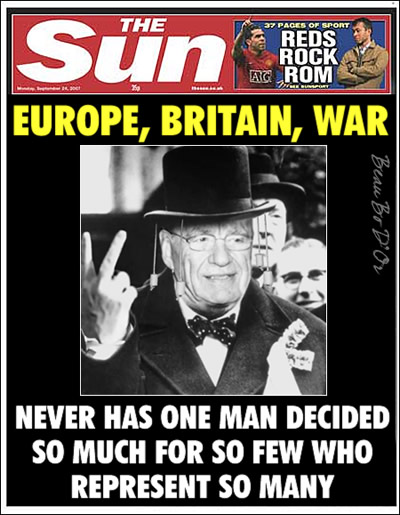
Murdoch 'warmonger'? A comprehensive summary of Murdoch policies

  (The relevant part starts about 1:10 in)

The image is from http://www.septicisle.info/uploaded_images/rupert_murdoch_europe-725350.jpg
The following article is from one of the many leftist or liberal sites, zines and blogs that have prospered on the web even as the mainstream, mass-market press has grown ever more narrow in its right-wing ideological slant; the Curran & Seaton book (Power Without Responsibility) I keep recommending tracks how this has come about in the UK, demolishing the myth of a liberal press.
The article is a comprehensive attack on Murdoch's record, values and operating methods, and is a useful summary of many of the key right-wing policies he's associated with (and thus NewsCorp).

Who is Rupert Murdoch?


Rupert MurdochIn recent years, Australian-born billionaire Rupert Murdoch has used the U.S. government's increasingly lax media regulations to consolidate his hold over the media and wider political debate in America. Consider Murdoch's empire: According to Businessweek, "his satellites deliver TV programs in five continents, all but dominating Britain, Italy, and wide swaths of Asia and the Middle East. He publishes 175 newspapers, including the New York Post and The Times of London. In the U.S., he owns the Twentieth Century Fox Studio, Fox Network, and 35 TV stations that reach more than 40% of the country...His cable channels include fast-growing Fox News, and 19 regional sports channels. In all, as many as one in five American homes at any given time will be tuned into a show News Corp. either produced or delivered." But who is the real Rupert Murdoch? As this report shows, he is a far-right partisan who has used his empire explicitly to pull American political debate to the right. He is also an enabler of the oppressive tactics employed by dictatorial regimes, and a man who admits to having hidden money in tax havens. In short, there more to Rupert Murdoch than meets the eye.
In 2003, Rupert Murdoch told a congressional panel that his use of "political influence in our newspapers or television" is "nonsense." But a close look at the record shows Murdoch has imparted his far-right agenda throughout his media empire.
MURDOCH THE WAR MONGER: Just after the Iraq invasion, the New York Times reported, "The war has illuminated anew the exceptional power in the hands of Murdoch, 72, the chairman of News Corp… In the last several months, the editorial policies of almost all his English-language news organizations have hewn very closely to Murdoch's own stridently hawkish political views, making his voice among the loudest in the Anglophone world in the international debate over the American-led war with Iraq." The Guardian reported before the war Murdoch gave "his full backing to war, praising George Bush as acting 'morally' and 'correctly' and describing Tony Blair as 'full of guts'" for his support of the war. Murdoch said just before the war, "We can't back down now – I think Bush is acting very morally, very correctly." [New York Times, 4/9/03; Guardian, 2/12/03]
MURDOCH THE NEOCONSERVATIVE: Murdoch owns the Weekly Standard, the neoconservative journal that employed key figures who pushed for war in Iraq. As the American Journalism Review noted, the circulation of Murdoch's Weekly Standard "hovers at only around 65,000. But its voice is much louder than those numbers suggest." Editor Bill Kristol "is particularly adept at steering Washington policy debates by inserting himself and his views into the discussion." In the early weeks of the War on Terror, Kristol "shepherded a letter to President Bush, signed by 40 D.c= opinion-makers, urging a wider military engagement." [Source: AJR, 12/01]
MURDOCH THE OIL IMPERIALIST: Murdoch has acknowledged his major rationale for supporting the Iraq invasion: oil. While both American and British politicians strenuously deny the significance of oil in the war, the Guardian of London notes, "Murdoch wasn't so reticent. He believes that deposing the Iraqi leader would lead to cheaper oil." Murdoch said before the war, "The greatest thing to come out of this for the world economy...would be $20 a barrel for oil. That's bigger than any tax cut in any country." He buttressed this statement when he later said, "Once [Iraq] is behind us, the whole world will benefit from cheaper oil which will be a bigger stimulus than anything else." [Guardian, 2/17/03]
MURDOCH THE INTIMIDATOR: According to Agence France-Press, "Rupert Murdoch's Fox News Channel threatened to sue the makers of 'The Simpsons' over a parody of the channel's right-wing political stance…In an interview this week with National Public Radio, Matt Groening recalled how the news channel had considered legal action, despite the fact that 'The Simpsons' is broadcast on sister network, Fox Entertainment. According to Groening, Fox took exception took a Simpsons' version of the Fox News rolling news ticker which parodied the channel's anti-Democrat stance with headlines like 'Do Democrats Cause Cancer?'" [Source: Agence France-Press, 10/29/03]
MURDOCH THE NEWS EDITOR: "When The New York Post tore up its front page on Monday night to trumpet an apparent exclusive that Representative Richard A. Gephardt would be Senator John Kerry's running mate, the newspaper based its decision on a very high-ranking source: Rupert Murdoch, the man who controls the company that owns The Post, an employee said yesterday. The Post employee demanded anonymity, saying senior editors had warned that those who discussed the Gephardt gaffe with other news organizations would lose their jobs." [NY Times, 7/9/04]
Just as Fox claims to be "fair and balanced," Rupert Murdoch claims to stay out of partisan politics. But he has made his views quite clear – and used his media empire to implement his wishes. As a former News Corp. executive told Fortune Magazine, Murdoch "hungered for the kind of influence in the United States that he had in England and Australia" and that meant "part of our political strategy [in the U.S.] was the New York Post and the creation of Fox News and the Weekly Standard."
MURDOCH THE BUSH SUPPORTER: Murdoch told Newsweek before the war, Bush "will either go down in history as a very great president or he'll crash and burn. I'm optimistic it will be the former by a ratio of 2 to 1…One senses he is a man of great character and deep humility." [Newsweek, 2/17/03]
MURDOCH THE BUSH FAMILY EMPLOYER: As Slate reports, Murdoch "put George W. Bush cousin John Ellis in charge of [Fox's] Election Night vote-counting operation: Ellis made Fox the first network to declare Bush the victor" even as the New Yorker reported that Ellis spent the evening discussing the election with George W. and Jeb Bush. After the election, Fox bragged that it attracted 6.8 million viewers on Election Night, meaning Ellis was in a key position to tilt the election for President Bush. [Source: Slate, 11/22/00; New Yorker, 11/20/00]
MURDOCH THE MIXER OF BUSINESS AND POLITICS: James Fallows of the Atlantic Monthly points out that most of Murdoch's actions "are consistent with the use of political influence for corporate advantage." In other words, he uses his publications to advance a political agenda that will make him money. The New York Times reports that in 2001, for example, The Sun, Britain's most widely read newspaper, followed Murdoch's lead in dropping its traditional conservative affiliation to endorse Tony Blair, the New Labor candidate. News Corp.'s other British papers, The Times of London, The Sunday Times and the tabloid News of the World, all concurred. The papers account for about 35% of the newspaper market in Britain. Blair backed "a communications bill in the British Parliament that would loosen restrictions on foreign media ownership and allow a major newspaper publisher to own a broadcast television station as well a provision its critics call the 'Murdoch clause' because it seems to apply mainly to News Corp." [Atlantic Monthly, 9/03; New York Times, 4/9/03]
MURDOCH THE NEW YORK CITY POLITICAL BOSS: The Columbia Journalism Review reported that during New York Mayor Rudolph Giuliani's first term "News Corp. received a $20.7 million tax break for the mid-Manhattan office building that houses the Post, Fox News Channel, TV Guide and other operations. During Giuliani's 1997 reelection campaign, News Corp. was also angling for hefty city tax breaks and other incentives to set up a new printing plant in New York City. Most dramatically, Giuliani jumped in to aggressively champion News Corp. when it battled Time Warner over a slot for the Fox News Channel on Time Warner's local cable system…Three years into Giuliani's first term, veteran Village Voice political reporter Wayne Barrett asked Post editorial page editor Eric Breindel if the paper had run a single editorial critical of the administration; Breindel, he says, admitted it had not. According to Barrett, the paper pulled off a perfect four-year streak" of not one critical editorial. [Columbia Journalism Review, 6/98]
Rupert Murdoch thinks of himself as a staunch anti-communist. But a look at the record shows that when his own profits are on the line, he is willing to do favors for the most repressive regimes on the planet.
MURDOCH THE DEFENDER OF REPRESSIVE REGIMES: The last governor of Hong Kong before it was handed back to China, Chris Patten, signed a contract to write his memoirs with Murdoch's publishing company, HarperCollins. But according to the Evening Standard, when "Murdoch heard that the book, East and West, would say unflattering things about the Chinese leadership, with whom he was doing satellite TV business, the contract was cancelled. It caused a furor in the press - except, of course, in the Murdoch papers, which barely mentioned the story." According to BusinessWeek, internal memos surfaced suggesting the canceling of the contract was motivated by "corporate worries about friction with China, where HarperCollins' boss, Rupert Murdoch, has many business interests." [Evening Standard, 8/13/03; BusinessWeek, 9/15/98]
MURDOCH THE APOLOGIST FOR DICTATORSHIPS: Time Magazine reported that while Murdoch is supposedly "a devout anti-Soviet and anti-communist" he "became bewitched by China in the early '90s." In an effort to persuade Chinese dictators that he would never challenge their behavior, Murdoch "threw the BBC off Star TV" (his satellite network operating in China) after BBC aired reports about Chinese human rights violations. Murdoch argued the BBC "was gratuitously attacking the regime, playing film of the massacre in Tiananmen Square over and over again." In 1998 Chinese President Jiang Zemin praised Murdoch for the "objective" way in which his papers and television covered China. [Source: Time Magazine, 10/25/99]
MURDOCH THE PROPAGANDIST FOR DICTATORS: While Murdoch justifies his global media empire as a threat to "totalitarian regimes everywhere," according to Time Magazine, Murdoch actually pays the salary of a top TV consultant working to improve the Chinese government's communist state-run television CCTV. As Time notes, "nowadays, News Corp. and CCTV International are partners of sorts," exchanging agreements to air each other's content, even though CCTV is "a key propaganda arm of the Communist Party." [Source: Time Magazine, 7/6/04]
MURDOCH THE ENABLER OF HUMAN RIGHTS VIOLATORS: According to the LA Times, Murdoch had his son James, now in charge of News Corp.'s China initiative, attack the Falun Gong, the spiritual movement banned by the Chinese government after 10,000 of its followers protested in Tiananmen Square. With Rupert in attendance, James Murdoch called the movement a "dangerous" and "apocalyptic cult" and lambasted the Western press for its negative portrayal of China's awful human rights record. Murdoch "startled even China's supporters with his zealous defense of that government's harsh crackdown on Falun Gong and criticism of Hong Kong democracy supporters." Murdoch also "said Hong Kong democracy advocates should accept the reality of life under a strong-willed 'absolutist' government." It "appeared to some to be a blatant effort to curry favor" with the China's repressive government. [LA Times, 3/23/01]
MURDOCH THE HIDER OF MONEY IN COMMUNIST CUBA: Despite a U.S. embargo of communist Cuba, the Washington Post reports, "News Corp.'s organizational chart consists of no less than 789 business units incorporated in 52 countries, including Mauritius, Fiji and even Cuba." [Washington Post, 12/7/97]
From union busting to tax evading, Rupert Murdoch has established a shady business record that raises serious questions about his corporate ethics.
MURDOCH THE UNION BUSTER: The Economist reported that in 1986 Murdoch "helped smash the British print unions by transferring the production of his newspapers to a non-union plant at Wapping in East London." The move "proved to be a turning-point in Britain's dreadful industrial relations." AP reported Murdoch specifically "slashed employment levels" at the union plant and said he would "dismiss the 6,000 striking workers" who were trying to force concessions out of the media baron. The London Evening Standard called the tactics "the biggest union-busting operation in history." [Sources: The Economist, 4/18/98; AP, 1/27/86; Evening Standard, 11/12/98]
MURDOCH THE CORPORATE TAX EVADER: The BBC reported that "Mr. Murdoch's die-hard loyalty to the tax loophole has drawn wide criticism" after a report found that in the four years prior to June 30, 1998, "Murdoch's News Corporation and its subsidiaries paid only $325 million in corporate taxes worldwide. That translates as 6% of the $5.4 billion consolidated pre-tax profits for the same period…By comparison another multi-national media empire, Disney, paid 31%. The corporate tax rates for the three main countries in which News Corp. operates - Australia, the United States and the UK - are 36%, 35% and 30% respectively. Further research reveals that Mr. Murdoch's main British holding company, News Corp. Investments, has paid no net corporation tax within these shores over the past 11 years. This is despite accumulated pre-tax profits of nearly $3 billion." [Source: BBC, 3/25/99]
MURDOCH THE LOVER OF OFFSHORE TAX HAVENS: When a congressional panel asked if he was hiding money in tax havens, including communist Cuba, Murdoch responded "we might have in the past, I'm not denying that." The Washington Post reports, "through the deft use of international accounting loopholes and offshore tax havens, Murdoch has paid corporate income taxes at one-fifth the rate of his chief U.S. rivals throughout the 1990s, according to corporate documents and company officials." Murdoch "has mastered the use of the offshore tax haven." His company "reduces its annual tax bill by channeling profits through dozens of subsidiaries in low-tax or no-tax places such as the Cayman Islands and Bermuda. The overseas profits from movies made by 20th Century Fox, for instance, flow into a News Corp.-controlled company in the Caymans, where they are not taxed." [Source: Congressional Testimony, 5/8/03; Washington Post, 12/7/97]
MURDOCH THE ABUSER OF TAX LOOPHOLES: Even though Murdoch changed his citizenship in order to comply with U.S. media ownership rules, many of his companies have remained Australian, allowing them "to utilize arcane accounting rules that have pumped up reported profits and greatly aided Murdoch's periodic acquisition sprees." IRS officials point out that "U.S.-based companies face U.S. taxes on their offshore subsidiaries in the Caymans and elsewhere if more than 50 percent of the subsidiary is controlled by American shareholders. But that doesn't apply to News Corp., an Australian company." [Source: Congressional Testimony, 5/8/03; Washington Post, 12/7/97]