Tuesday, 17 April 2012

Tues17th: 13A task

Today YOU will be researching and delivering the lesson, which ties into our 1st practice MediaReg essay on arguments for/against the PCC

You will each have up to 9.15 to research at least 1 source (which you identify to me so I can confirm that everyone is using a unique source/article), type up your notes (keep them BRIEF + to the point; only quote where absolutely necessary - we have just 30mins to get feedback from each person AND discuss these findings) either for or against the PCC. Reflecting the balance of the arguments, 3 of you will research the pro-PCC arguments, the rest of you the anti- lines.
The quickest way to do this is to type into Word, then copy/paste into a blog post comment at the end.
If you quickly get through one source, make a start on another!


By 9.15, deliver your findings as a comment to this post, starting this comment with your name, the URL of the source/s you used (+author/organisation name + publication date if thats not already obvious from the link + is stated on the web page), + then a list of points (each on a separate line).
After discussing the overall findings I'll compile all of these (+ those from the other class) this evening into a Word document, and embed it here.

...and here it is!
13A PCC Research Tues 17th April 2012

Sunday, 8 April 2012

BBC R6 saved by social media

The BBC had decided to scrap parts of its media empire to help make cost savings required by the license deal struck with the Tory-led government, and Radio 6Music was one of those BBC brands set for the scrapheap ... then a Facebook campaign was launched ...
Read all about it at http://www.radiotimes.com/news/2012-02-02/6-music-saviour-was-very-close-to-stopping-the-whole-campaign

Friday, 6 April 2012

James Murdoch humiliated + pushed out

You'll find pretty much all you need to know from this article by the author of a biography of his old man: http://www.guardian.co.uk/commentisfree/cifamerica/2012/apr/04/james-murdoch-news-corp-scion
You can find much more at www.guardian.co.uk/media/jamesmurdoch
(As I've previously noted:
Michael Wolff's The Man Who Owned the News: Inside the Secret World of Rupert Murdoch (look at the 'Customer who bought this also bought' list for more useful reads - this one has the 'Look Inside' feature meaning you can preview some content for free and take notes).
If you're doing business, Murdoch/NewsCorp makes for a great case study - including the current moves to shift him out of NewsCorp by shareholders.)

NEW Phone Hacking book

This has been extensively previewed in The Guardian through Roy Greenslade's column if you're feeling too fiscally challenged to purchase a copy; contains chapters on the history of press regulation, takes things up to date, and includes proposals for the future of press regulation - rather neatly spanning the ground you have to cover for your exam...
You can find the Guardian previews by googling 'guardian the phone hacking scandal: journalism on trial*'

This book on Amazon;
Guardian short book on hackgate;
another hackgate book;
Michael Wolff's The Man Who Owned the News: Inside the Secret World of Rupert Murdoch (look at the 'Customer who bought this also bought' list for more useful reads - this one has the 'Look Inside' feature meaning you can preview some content for free and take notes).
If you're doing business, Murdoch/NewsCorp makes for a great case study - including the current moves to shift him out of NewsCorp by shareholders.

Hacked off campaign

Original logo
Lest you're unaware, Hacked Off is a useful source: a campaign group formed in response to the inadequate response of the Met Police (the subject of multiple inquiries and increasingly likely to lead to court cases), with Hugh Grant now their most prominent spokesperson.
Look closely at their logo, which reflects their distrust of the actual purposes of Leveson...

Here's how the Media Standards Trust describes them:
Can you spot the difference now...
Hacked Off was founded to campaign for a public inquiry into illegal information-gathering by the press and into related matters including the conduct of the police, politicians and mobile phone companies. Only a full public inquiry, we argued, could put the truth of the hacking scandal before the public and ensure that necessary lessons were learned. The Milly Dowler revelations on 4 July convinced the public and the political world of the need for such an inquiry, and the campaign is now focused on monitoring the Leveson Inquiry and pushign [sic] for press reform.
 Their own website: http://hackinginquiry.org/

btw, you add [sic] where a source contains a spelling error, denoting its not YOUR error

Sky email hacking: Public Interest Defence

The following is an example of how you can combine Use of Examples (a case study of this instance of hacking), EAA + Use of Terminology (in analysing the pros/cons of the concept of 'public interest defence', and citing specific law which may overrule this: the Computer Misuse Act). Below you'll find differing lines from Sky, Guardian, Indie, Hacked Off and Reuters, plus a linked Roy Greenslade article on the wider concept.
Huge story breaking 1st week of April 2012: Sky has admitted to using email hacking for at least two stories it ran ... but claims there is a public interest defence. Sky trumpeted about 'obtaining' emails from the faked-death John Darwin in 2008; his wife pocketed a fortune from life insurance and they went to Panama to live it up (then rather foolishly posed for pictures with an estate agent).
Here's how The Guardian broke the story. An excerpt:
Making only a minimal effort to hide the basis of the story, Tubb's report said Sky News had "discovered an email" from John to Anne dated 31 May 2007, in which he says changes to visa regulations meant he could no longer stay in Panama, where he was hiding on a tourist visa. The report cited evidence from several emails between the couple, including a "final email" from Anne that was not, "as suggested in court", evidence of a "massive row" between them, an email that Tubb said had been "handed to the police by Sky News".
The story displayed a picture of "John and Anne Darwin's masterplan", showing a detailed diagram that had apparently been produced by Darwin, and claimed to have obtained detailed financial accounts prepared by Darwin. In another story, published in November 2009, Tubb quoted directly from an email written by John Darwin to his wife in 2007, explaining that their property in Panama had been valued at $1m and adding: "You're a filthy rich gringo". But a link to copies of the couple's emails is now dead.
The broadcaster also published a voicemail message on its website, dated 19 May 2007, in which Anne Darwin is clearly heard leaving a message for her husband. The voicemail, part of an interactive graphic, ends with her saying "I'll try and catch you tomorrow. Love you," which the broadcaster said showed "she was doing as much of the running as he was".
Sky News said this was not obtained by phone hacking and a spokesman said: "All of the material obtained by Sky News was via the Darwins' computer-based email accounts. As we have said previously, Cleveland Police were made aware of the source of the material when Sky News shared it with them. We stand by our editorial decisions, which were justified in the public interest."
Sky News responded today by accusing the paper of double standards; here's an excerpt:
Some of the most important stories have involved breaking the rules in some way. For example, the Daily Telegraph's exposé of the MPs' expenses scandal was very clearly in the public interest, but only happened because the newspaper took the decision to pay for stolen data. They have been widely applauded - deservedly - for doing so.
Indeed, if it was looking for further examples, the Guardian could have found them much closer to home. Its respected investigative reporter David Leigh has admitted hacking a phone in pursuit of a story. The Guardian's sister paper, the Observer, was found on more than 100 occasions to have commissioned information from a notorious private investigator, who was convicted in 2006 of illegally obtaining private data. In each case, a public interest justification has been claimed.
The story has lead headlines for days now. The Indie was one of several to flag up a key point of law which potentially undermines Sky's line that there was a public interest defence:
Although no one has been arrested for the computer hacking, there is no public interest defence in the Computer Misuse Act. The development follows the revelation that The Times, another part of the Murdoch news operation, was found to have hacked into the emails of the blogger Nightjack, who the paper outed as the serving police officer Richard Horton.
“Hacked Off today renews its calls for a public interest defence in law after Sky News confessed to hacking into emails, claiming it did so ‘in the public interest’.
“Yet because there is no public interest defence in law for the Computer Misuse Act, Sky has to rely on the discretion of the prosecution services not to prosecute.
“This is unsatisfactory. If Sky News believes there is a clear public interest to hack into emails then it should have a clear and consistent legal defence for its actions.
“Journalists would feel confident to speak openly about the methods they use to discover stories in the public interest if they knew there was a proper defence for their actions in law.
“Hacked Off hopes that the Leveson Inquiry will recommend the introduction of a formal public interest defence in law for the protection of journalism.”
If you want an ostensibly neutral (I don't think such a thing exists) news source, here's how news agency Reuters reported the story.

Final word from me on this: NewsCorp has been guilty of flagrant abuse, and intrusions into the privacy of 1000s, but don't dismiss Sky's line of argument just because the source is arguably tainted; consider the merits of the argument, not just the source. Read more on the public interest defence in this book extract from the Roy Greenslade column.

Friday, 30 March 2012

Challenging Chomsky: Galloway's win

While I broadly agree with the Chomskian propaganda model, it has been been attacked by many academics, often for being too simplistic (and underestimating the active power of the audience).
Here's an interesting example which you can use if you wish to add a counterview on Chomsky (its always a sign of a good academic - including an A/A* grade A-level student! - to show an ability to reflect on the strengths and weaknesses of any theory or academic source)...
George Galloway won an astonishing by-election victory in Bradford last night - despite typically fierce, extremely negative press. An avowed left-winger, he proved too left-wing for Labour, now a centrist party at best (many would argue actually right-wing), and is even generally criticised in the two centre-left papers (Mirror and Guardian) which might be expected to be supportive (his ties to reactionary Islamist clerics may explain this).
In short, here's a radical voice which the media generally filter out, not least through 'flak' ... yet he still won this election, and by a long way. Read the section from this article below, and you'll see that there's an interesting argument here for the growing power and influence of YouTube over more traditional news media ... should it be regulated by OfCom to the same level TV is? (If you look ahead to one of your homework essays you'll see this is a useful case study...)
The majority of those pledging their support had a number of things in common. They were either a first time voter or a disaffected Labourite, and all wanted to congratulate him on his robust stance against the wars in Afghanistan and Iraq. Many said they used to watch him on Press TV, the English-language Iranian controlled channel – until it was taken off air by the government earlier this year.
More still had watched YouTube clips of Galloway ripping into his detractors, whether in front of the US senate in 2005 or in a classically adversarial interview with Sky News about Gaza. These, Galloway proudly refers to as his "greatest hits". Only a handful recognised him primarily from his appearance on Celebrity Big Brother in 2006, when he dressed in a red unitard and pretended to be Rula Lenska's pussycat.
...

Monday, 26 March 2012

Royals/Press - new articles

There's plenty in the links list but here's a few recent articles of note:
http://www.guardian.co.uk/lifeandstyle/2012/mar/25/tabloid-tales-harry-eva-wiseman (how singleton Harry has replaced poor Jen [Aniston] as tabloid obsession)
http://www.guardian.co.uk/media/mediamonkeyblog/2012/mar/01/royal-highnesses-naked-centrefold-cosmopolitan - Cosmo publishes pics of royal lookalikes
http://tabloid-watch.blogspot.co.uk/2012/03/sunday-express-uses-photo-from-2007-for.html - The Desmond-owned S.Express adds a new line to its low-cost stack of Diana front pages; if those stories are over 10yrs old (but still regularly getting an airing on this newspaper), then this isn't bad: using a 5yr old pic of the nation's favourite Nazi-fancy dressing royal for this story, which typically seems to have very, very little credibility or substance. So much for the Editors Code Clause 1 on Accuracy.

Tuesday, 13 March 2012

Gambling Commission also regs TV

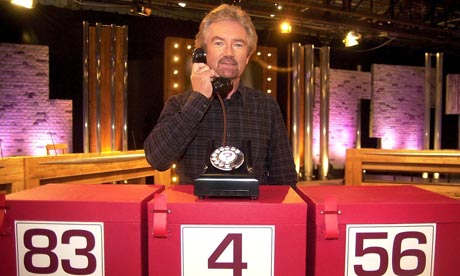
'Deal or no Deal' could be ruled illegal; the Gambling Commission has new powers to define gameshows or elements of TV shows with no element of skill as gambling, a topic OfCom has no formal position on. See http://www.guardian.co.uk/media/2012/mar/13/deal-or-no-deal-gambling-c4
Prese
The Gambling Commission will meet senior executives at Channel 4 in the next few days to discuss concerns that its hit teatime gameshow Deal or No Deal may constitute gambling.
Noel Edmonds on Deal or No Deal
To be banned? I'll give you evens it survives...
The commission is due to publish new advice on the implications of the Gambling Act for broadcasters and producers next month.
It is understood to have particular concerns about the Noel Edmonds gameshow, which broadcast for the first time on Channel 4 in 2005.

Friday, 9 March 2012

DailyMash: PM lipsyncs Blair

Be warned that the site carries some adult ads, but the Daily Mash is a skilful satire of some of the rubbish we see in every paper (yes, including the Guardian!) day in, day out; its name is closest to the Mail, but there's no left/right agenda here, just 'a pox on all your houses'. (Lest any of you are somehow unaware, a mash-up is a term made popular by bedroom DJs double-tracking 2 songs and playing both at once)
Here's a rather topical example:
Cameron Iran speech 'lip-synced' to video of Blair on Iraq
(with thanks to Mr Thompson for bringing this to my attention)

Read More:
Wikis: mashup (video); mashup (digital); mashup (music).
The Daily Mash is a UK equivalent of the now giant US spoof news site, The Onion

OfCom gets tough on Murdoch!!!

I'm not often taken by surprise by media matters, but this one does come as a shock...
24 hours after the PCC announced its intention to dissolve itself, form an interim body (what a nonsense!), and form a new press self-regulator in time to try and pre-empt Leveson's report and recommendations, OfCom drops its own bombshell. According to R5 news this morning, it is set to formally investigate whether Murdoch meets the 'fit and proper person' test to head a broadcast media organisation.
While I think this is a laudable move (that perhaps should have happened some time ago), the surprise is that it comes now. The Tories openly spoke about scrapping OfCom and 'repatriating' (taking back) the powers of the independent regulator into the DCMS (government) during the election campaign, leading to OfCom - disgracefully I felt - abandoning the pro-active stance it had been developing and shrinking itself in advance of such Tory action.
So, two years into the Tory-led coalition government (the Culture [DCMS] Secretary is a Tory, Jeremy Hunt), this is effectively a fight-back by our 'independent' regulator (the extent to which they'd bowed to government pressure, and changes made by Hunt in office, have made the extent of the independence rather more questionable than before - though part of the Tories' hostility was that they felt OfCom chairman Ed Richards was a Labour place-man).
Lets be clear though: the Murdoch issue is not confined to one party. Tony Blair went to extraordinary lengths to win Murdoch/News International's support for Labour; in 1996 he flew to Australia to address a News Corp shareholders conference and hold private talks with Murdoch, who shortly after had his UK papers announce their support for Labour (who then trounced the Tory government in the 1997 election). Labour desperation to retain that support seemed to influence their media policy, as it had the Tory Thatcher government before them, with new media laws seemingly designed specifically to advantage Murdoch's media empire. Even after Murdoch reverted to Tory-supporting in Sept 2009, Gordon Brown's Labour tried desperately to win back that support, leading them to back off ensuring a proper investigation was held into phone hacking (Brown himself was not only hacked but allegedly blackmailed by The S*n).
Video: Sun abandons Labour for Conservatives [PressTV news report]

That doesn't mean there isn't a left/right issue though: 'New Labour' was widely seen as a basically right-wing party, and Blair the real heir to Thatcher - the party Murdoch's papers supported was no longer a left-wing party, having concluded that with such a hostile right-wing press in the UK, there was no hope of left-wing policies getting them elected.

Some further reading:
'Snouts in the trough: 'Independent' media regulator costs taxpayer millions and holds Middle England in contempt' - classic right-wing pov from Daily Mail in 2011
Talk to anyone in the insular, self-regarding, oh-so-liberal London media world about Ofcom chief executive Ed Richards and they will say he’s brainy, self-assured and carries a vast amount of information around in his head.
 ...
But more than anything, Ed Richards is a leading member of the New Labour political establishment, an interconnected, back-scratching mafia that, while bankrupting Britain, made its own members seriously rich.
For Richards has done extremely well for himself — the total amount of his salary and pension benefits since he took the helm of Ofcom in 2006 is heading towards the £2 million mark. [...]
www.politics.co.uk/reference/ofcom - Brief but solid outline
'Jeremy Hunt's links with Rupert Murdoch empire under scrutiny' - D.Telegraph report, Dec 23rd 2010
'MPs attack Sky News spin-off to clear way for BSkyB bid: Jeremy Hunt, the Culture Secretary, came under fire from MPs for his decision to clear the way for Rupert Murdoch's News Corporation to takeover BSkyB.' - D.Tele report 3rd March 2011 (with a video report on the page):
In a statement in the House of Commons Mr Hunt said he was minded to wave through the proposed deal after News Corp undertook to spin off Sky News into a new independent company.
Labour's Dennis Skinner called the decision a "disastrous day for democracy", while Green Party leader Caroline Lucas said Mr Murdoch had an "unhealthy influence" over Britain's media landscape. [...]
There were signs of the fightback from OfCom in January 2012: 'Ofcom chief: new regulatory regime could cover all media: Arguing for common standards across TV, web video and digital publishing is not call for 'super regulator', says Ed Richards' - Media Guardian report (and the proposal surely would merit the descriptor super regulator'?!)
Wiki
Indie reports on the story I heard on R5: 'Ofcom looks at stripping Murdoch of BSkyB: Mogul under scrutiny in 'fit and proper' test' (9th March 2012) Details 'Project Apple', under which OfCom is investigating whether Murdoch has failed the 'fit and proper persons' criteria required under the 1990 and 1996 Broadcasting Acts for anyone holding a broadcast license. 
'Dancing around the inevitable: The Oxford Media Convention by David Elstein, 27 January 2012 Regulatory reform of Britain's media is coming: the question is how, and when. This year's annual Oxford event brought the big players together to wrangle over the future of the press.'
Interesting + useful site, not just the article; from the SpinWatch blog: 'Ofcom and BSkyB bid: We should have looked at News Corporation’s political influence' [1st Feb 2012]
Ed Richards, Ofcom’s chief executive, told Lord Justice Leveson that if given another chance to look again at News Corporation’s aborted bid for total control of BSkyB it would have placed more emphasis on the “risk to the democratic process.”
...
on reflection, Ofcom now felt the proposed BSkyB takeover did raise the need for a wider review of plurality because the conventional analysis of the concentration of media ownership was based on the proportion of readers and viewers and that was deficient because it did not measure the influence on the political process which a company might exercise.
Lord Justice Leveson said Ofcom’s admission that its regulatory regime “did not do the job properly” with regard to the democratic process was highly significant to the work of his inquiry. The judge is taking evidence from politicians and media proprietors in May and he said he would like to know before the end of June the scope of any recommendations which Ofcom intended to make to the government; he and his team of assessors intended discussing possible options by early July.
Earlier in his evidence Richards explained that companies could acquire “a very substantial share of the media market” not solely by mergers or similar transactions but also by the sudden closure of other media outlets.
“You could find because of organic growth that a media company could have too much political power...the current legislation has no means of assessing that...that is a very serious deficiency in a highly dynamic market.”
After Lord Justice Leveson said Ofcom’s investigation into the scope of its own regulatory role “plays absolutely full square” into the work of  his own inquiry, Colette Bowe, Ofcom’s chairman, said the regulator would do its utmost to ensure that the judge was supplied with details of any proposals Ofcom intended to make to the government.
She agreed with Ed Richards about the deficiencies in Ofcom’s power to look into the impact of significant power in the media market; Ofcom already had such powers in relation to the telecoms sector but did not have the same powers with regard to media plurality and the impact on the democratic process.
During their oral evidence neither the judge nor the inquiry’s counsel Corine Parry Hoskins asked either Richards or Bowe about the pre-election pledge given by David Cameron in June 2009 that a future Conservative government would remove Ofcom’s policy-making functions and return them to the Department of Culture, Media and Sport.
Cameron said that in future Ofcom’s remit would be “restricted to narrow technical and enforcement roles” because the regulator had become an “unaccountable bureaucracy” which was taking decisions which should be the responsibility of ministers “accountable to Parliament.”
The Sun hailed Cameron’s announcement as the first sign that a new Conservative-led government would curb the activities of the “Ofcom busybodies.”
But Cameron’s promises to curtail Ofcom seem to have been dropped in their entirety, along with News Corporation’s bid to take total control of BSkyB – all part of the fallout from the revelations about the hacking of the mobile phone of the murdered schoolgirl Milly Dowler which resulted in the closure of the News of the World in July 2010.

Thursday, 8 March 2012

Sorry we said you raped a 14-year-old

Last post for this morning, again coming from a Tabloid Watch blog report. It speaks for itself, but note that it reflects that tawdry reporting values are not a left/right issue: this eg comes from a Sunday paper published by Mirror Group Newspapers (MGN):

Sorry we said you raped a 14-year-old

The natural father of Peter Connelly (Baby P) has been awarded substantial damages after The People accused him of being a sex offender who had been convicted of raping a 14-year-old girl.

MediaGuardian reports:

Mr Justice Bean ordered Mirror Group Newspapers, publisher of the People, to pay an initial £30,000 in damages plus costs of £35,000. The damages payout will rise to £75,000 if the publisher loses permission to take the ruling to the court of appeal.

The allegations were contained in two paragraphs in a crime supplement in the People about Baby P's mother, who had separated from the child's father, referred to in court as KC. They appeared in a 19 September 2010 article headed "Tortured to death as mum turned a blind eye"...

Bean said in his written judgment: "It is difficult to think of any charge more calculated to lead to the revulsion and condemnation of a person's fellow citizens than the rape of a 14-year-old girl."

KC said in his witness statement that he was "shocked and upset beyond words" by the false libel, which he first learned about in phone calls from close friends.

The judge said the appropriate starting point for the damages was £150,000. But he reduced this by half, to £75,000 because Mirror Group Newspapers moved swiftly to apologise and correct the error.

The Independent added:

Heather Rogers QC, appearing for MGN [Mirror Group Newspapers], told the High Court hearing: "This was a mistake that MGN regrets and it has apologised to the claimant, and I repeat that apology on its behalf in this court."

However, she denied KC had been badly treated, or that MGN had conducted any kind of "campaign" against him, or dismissed his legitimate complaint.

Today, Ms Rogers argued that MGN should be allowed to appeal on the grounds that the compensation order was too high and "disproportionate". 

Star + inaccuracy: Eurovision

The Tabloid Watch blog is a great source for specific examples of how our press routinely flout the Editors Code they're supposedly governed by, article one of which governs accuracy.
Two recent egs which neatly sum this up: obviously invented 'reports' in the Star about Russell Grant, and then Atomic Kitten, being picked for the UK's Eurovision entry.

Mail + inaccuracy/anti-BBC

At http://tabloid-watch.blogspot.com/2012/03/swamped-with-complaints.html you can read of how the Mail labelled 3 complaints about the BBC as 'swamped', a good eg of the anti-BBC agenda/bias that is evident in most of the national press, whose owners are ideologically opposed to 'public sector' or state control of any business and would benefit commercially if the BBC was privatised or simply ceased to exist.

OfCom: We can't stop Freeview porn!

Incredible admission by OfCom, our 'super-regulator' of the broadcast industries: two porn stations carried on the Freeview system (and thus free-to-air, available to anyone of any age) are beyond its jurisdiction. The Dutch-run porn channels don't fall within UK control they say, in an interesting echo of the political fix that allowed Murdoch's News Corp to stretch credibility by claiming to be based in mighty Luxembourg (a tax haven, conveniently, with a smaller population than Leeds) and thus avoid the regulations that apply to 'terrestrial' broadcasters BBC, ITV, C4 + C5.
Very useful article/issue/case study for the European dimension to UK regulation, which I've blogged on previously. Read http://www.guardian.co.uk/media/2012/mar/07/freeview-porn-ofcom-action for more.